










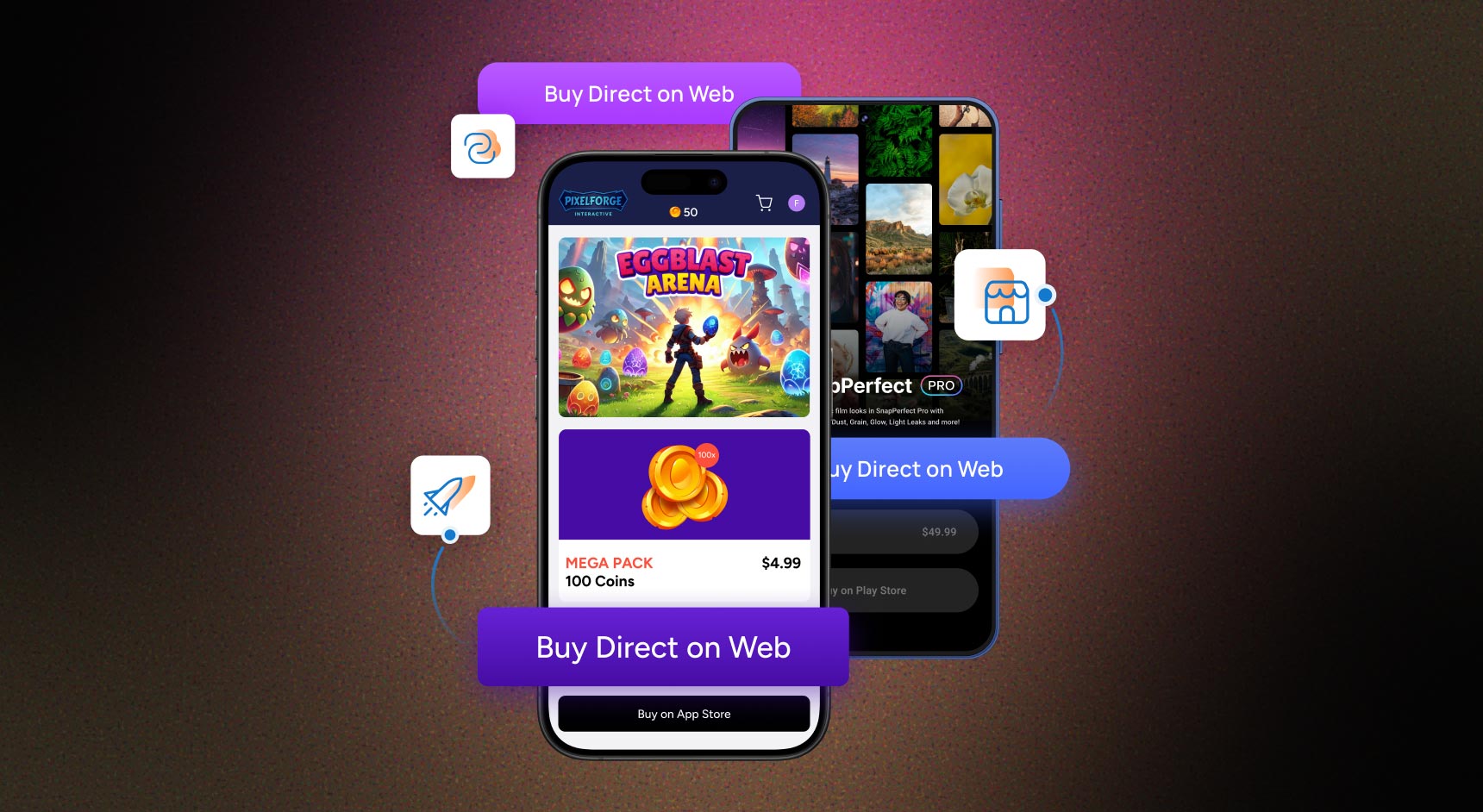
Key Takeaways About Selling Outside the App Stores:
- Mobile app marketplaces such as the Apple App Store and Google Play Store make app distribution easy, but they charge steep fees.
- There are a few important components to selling outside the app marketplaces, such as choosing a payments partner, setting up user accounts, and structuring your purchases and packages.
- A merchant of record such as FastSpring can make selling globally much easier for mobile app and game publishers.
If you’re not sure how to sell an app direct to consumer (also referred to as D2C or app2web) outside the app marketplaces — or if you’re looking for a new way to monetize your mobile app or game — you may be wondering what options you have.
Steep fees from platforms like the Apple App Store and the Google Play Store can understandably cause game developers and app creators to look beyond the convenience, discoverability, and ubiquity of traditional app marketplaces.
Historically, restrictions from the platform providers have made that difficult — but as a result of ongoing court cases along with the development of new laws and regulations, the mobile landscape is changing.
TL;DR: If you’re looking to sell outside Apple’s App Store and Google’s Play Store, you may have more options than you thought.
In this article, we’ll cover:
- How mobile app marketplaces work and the fees they charge.
- How to sell outside app marketplaces and the tools you’ll need to do so.
- Legal and regulatory updates regarding app sales and monetization.
FastSpring is how gaming studios and mobile app makers sell in more places around the world. For over two decades, FastSpring has been a payment provider you can use to sell apps, games, or in-game items on your website, web shop, or embedded directly into your app with fully customizable and branded checkouts just for you. FastSpring allows you to offload the complexity of global payments, sales tax and VAT compliance, player payments support, and many other aspects of payments management. Spend less time managing your payments and compliance and more time making great apps! Set up a demo or try it out for yourself.
Note: Information in this article was validated at time of publishing and is subject to change.
How Mobile App Marketplaces Work
Making up over 99% of mobile OS market share globally, Android with the Google Play Store and iOS with the iPhone App Store have enjoyed a duopoly over mobile app distribution and mobile app ecommerce worldwide. While those markets are beginning to open up, it’s helpful to understand the business model that app marketplaces have traditionally worked under.
On the plus side, because major app marketplaces are used by basically every human on earth with a mobile phone, the ability to attract new users for your app or players for your game is unmatched.
Marketplaces make it easy and convenient for users to download and pay for new apps and in-app purchases through a marketplace and within an ecosystem they already trust, and with payment methods they’ve already saved to their account.
Marketplaces also make it easy for mobile app developers to distribute their apps. They manage important transaction factors such as varied payment methods and currencies, fraud, tech support related to the transaction, and collecting and paying sales taxes.
But that ease of use can come at a steep price for developers.
Fees and Commissions Charged by Major App Marketplaces
Assuming your game or app is accepted by the mobile app store app review gatekeepers in the first place, the complete lack of competition ensures that the fees associated with sales via iOS and Google Play app stores are very high — usually around 15% on the first $1 million in sales annually and up to 30% on revenue streams exceeding $1 million per year.
That’s on top of the $99 per year membership fee required to join the Apple Developer Program, create your developer account, download Xcode, and access App Store Connect.
Those fees also apply to in-game purchases as well. This means that even if you intend to release a free app but monetize it using in-app purchases, you and/or your players and users will still be burdened by paying steep fees to the app stores.
Passing App Store Costs on to Consumers
Some apps have taken efforts to make it clear that at least a portion of high app store fees are being passed along directly to buyers, but that there are lower-cost options instead.
Adding Fees to Subscriptions Purchased via App Marketplaces
When Otter — an AI meeting agent and transcription app — revamped its pricing options in mid-2023, there was one particularly notable option for Pro plans: Paying for a yearly subscription via the Apple App Store or Google Play Store cost users an extra $10, increasing the price by about 8% from $119.99 to $129.99 USD.
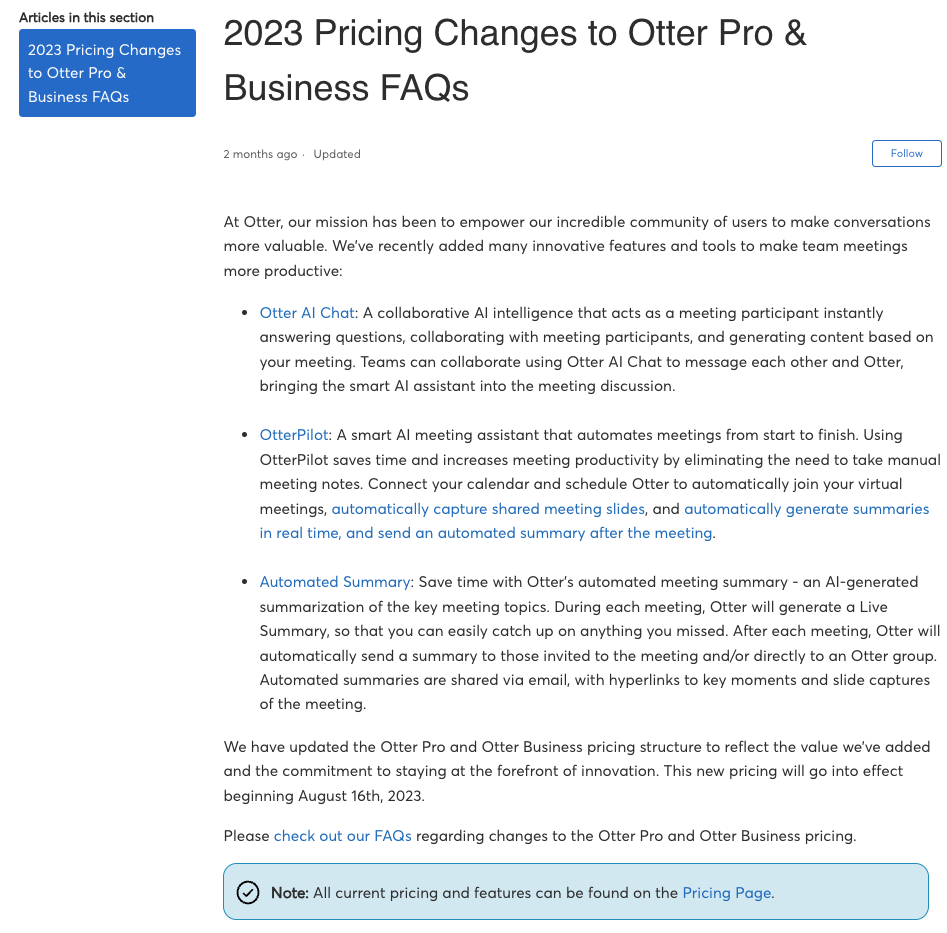
To explain how users could avoid this upcharge, Otter placed a green “Tip” box just below the Otter Pro pricing grid, encouraging users to “Learn how to move your Apple App Store or Google Play Store subscription to Otter via Web.”
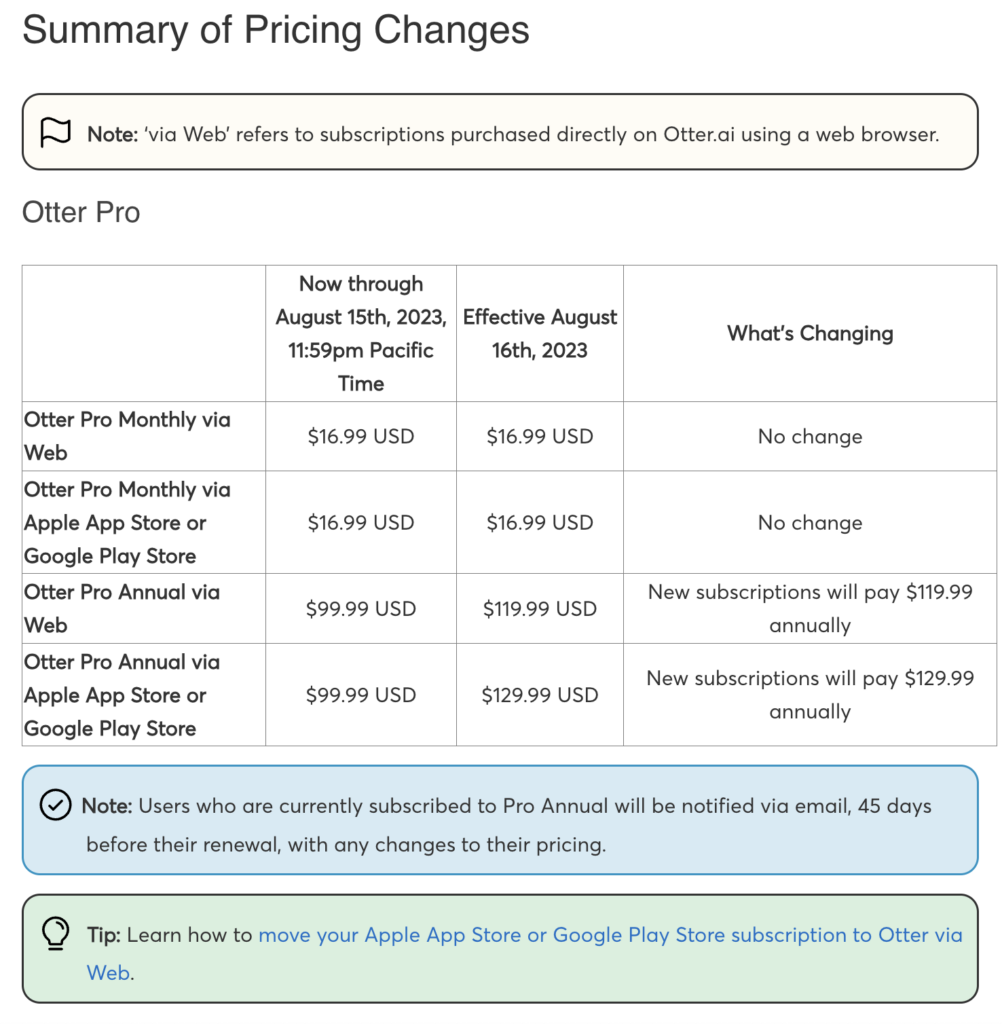
To address this pricing discrepancy more directly, the FAQ section at the bottom of the announcement page stated the higher price via app marketplaces “reflects the additional charges required to host the Otter.ai subscriptions on both Apple and Google’s app stores.”
It went on to explicitly recommend users cancel their current Apple App Store or Google Play Store subscription and re-subscribe via Otter’s website.
At the time of this writing, it appears that pricing for Otter Pro is now the same whether the user signs up via the Play Store or via web directly from Otter.ai, but their help page (linked above) about how to switch to a web subscription is still up, and the page mentions two additional benefits besides savings: access to the Otter support team if you have any subscription issues, and easier account management with access to upgrade options that aren’t available in the app.
Offering Discounts for Direct Purchases
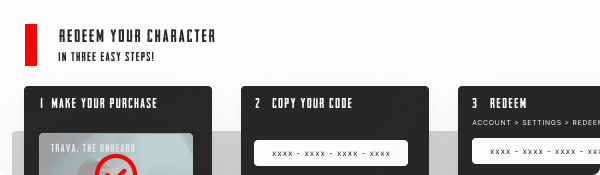
Subsequently, game and app developers may opt to offer discounted prices to users if they purchase outside of the app via an external user account that’s linked back to the app.
Developers can advertise these kinds of discounts and user accounts on their websites or in the app, depending on app marketplace regulations and location.
App devs make it easy for a user to sign up by simply opening the app on their phone, tapping a button to create a user account, and completing registration.
Then users can easily make purchases from the developer’s website directly, for much less than they would pay if they made the same purchases within the app. (More on user accounts below.)
More App Developers Are Selling D2C
While there are many benefits to selling games and apps through the iOS App Store and Google Play, the downsides on pricing & fees and the limitations on game distribution mean that as court cases continue and new regulations open up the markets, more and more developers will be wondering how they can implement a D2C strategy for their app or game.
In fact, by the middle of 2025, the gaming industry leaders we surveyed were already using direct-to-consumer monetization at a rate of 57%, and when combined with those not yet using D2C but planning to within 12 months, about 83% of all those surveyed will be using it by mid-2026.
Read more of the illuminating gaming industry survey results in our post, Massive Gaming D2C Survey From FastSpring and Omdia.
How to Sell Apps Outside App Marketplaces
In the Otter example above, even though Otter’s app is downloaded via the Apple App Store or the Android Play Store — and Otter was charging a higher price if users paid for their yearly Pro subscription via those stores — there was still a lower-cost option for their users: Downloading the app from one of the stores, but paying for their service on Otter’s own website using a different payment services provider (PSP).
This model is an example of the difference between distributing an app through the app marketplaces, and monetizing an app through the app marketplaces.
Even if downloads of your app are captive to proprietary stores, that doesn’t mean it’s the only way users can pay for your service or features.
Here are some of the key things to consider when setting up your own app monetization option outside of major app marketplaces.
Choosing a Payment Provider
Step one is choosing how you’ll accept payments outside app marketplaces.
There are many options for payment services providers (PSP) and merchants of record (MoR) on the market that you can set up to take payments outside of device-captive app stores.
But there is a key difference between payment services providers and merchants of record.
A PSP helps businesses sell a product by handling the specialized services and back-end connections needed to do so (such as connecting payment gateways, payment processors, and a merchant account).
An MoR like FastSpring does all that and more — from handling payment processing to taking on important responsibilities such as worrying about card brand rules, regulatory rules across jurisdictions, risk management and fraud prevention, handling refunds and chargebacks, sales taxes, VAT, and GST, and more. That includes calculating, collecting, and remitting taxes.
FastSpring is how gaming studios and mobile app makers sell in more places around the world. For over two decades, FastSpring has been a payment provider you can use to sell apps, games, or in-game items on your website, web shop, or embedded directly into your app with fully customizable and branded checkouts just for you. FastSpring allows you to offload the complexity of global payments, sales tax and VAT compliance, player payments support, and many other aspects of payments management. Spend less time managing your payments and compliance and more time making great apps! Set up a demo or try it out for yourself.
Can I Just Use Stripe?
Before you jump to considering an even simpler and lower-cost PSP such as Stripe, note that it’s very simple — Stripe is not a merchant of record.
Because they do not assume the same responsibilities an MoR like FastSpring does, you will still be responsible for important tasks such as managing risk, dealing with chargebacks, and handling taxes.
Stripe has multiple upgrades available to fill some of those gaps, but each upgrade package will continue to increase the price anyway. Learn more about how Stripe charges for their Tax upgrades in our article 2Checkout vs. Stripe vs. FastSpring: Comparing Payments, Taxes, and Platform Features (+ Pricing).
It can be very easy for SaaS companies and app businesses to outgrow Stripe, so it may be easier to start with a more robust merchant of record from the outset, particularly if you plan to grow quickly and/or serve customers globally.
FastSpring Steer SafeTM Makes Web Purchases Very Easy for Mobile Users
For a super smooth purchase flow that sends app users from your app to your website and right back when the purchase is complete, FastSpring now has Steer SafeTM, an approach to monetizing apps with the fastest, least-taps paths possible.
Easily add purchase buttons or links directly in your mobile app or game, and securely pass player info, product info, and more to your FastSpring-powered checkout on the web. Then quickly return the user to the app to get right back to utilizing their purchase.
To learn more and even see gifs of the purchase process in action, check out our Steer SafeTM posts about games on iOS, games on Android, or mobile apps on both iOS and Android.
Setting Up User Accounts
To connect purchases between your own checkout option and your app that was downloaded from an app marketplace, you’ll likely need some kind of user account system for users to track — and activate in-app — their purchases.
User accounts allow users to make purchases outside of the App Store or Play Store, then sign in to your app to see the purchase credited there.
In the case of FastSpring, we also provide consumer support to users. If they have any issues with their purchase or their purchase account, we’ll be there to help — making one less thing for you to worry about.
Structuring Purchases and Packages
Purchases tied to users’ accounts are often in the form of in-app currency or subscriptions.
In-App or In-Game Currency
To monetize your app using in-app or in-game currency, the currency is purchased using real money on your site and then redeemed in your app for in-app items, features, etc.
In the case of many game apps, the apps use an in-game currency such as coins, gems, gold, or a unique fictional currency that users can redeem for bonuses within the game. The currency can usually be purchased in various packages, with web-exclusive pricing offered if users leave the app and buy straight from the game developer’s site.
Users can then check out with a typical online purchase experience, such as with FastSpring’s online checkout with built-in user experience and conversion optimization.
FastSpring is how gaming studios and mobile app makers sell in more places around the world. For over two decades, FastSpring has been a payment provider you can use to sell apps, games, or in-game items on your website, web shop, or embedded directly into your app with fully customizable and branded checkouts just for you. FastSpring allows you to offload the complexity of global payments, VAT and sales tax compliance, player payments support, and many other aspects of payments management. Spend less time managing your payments and compliance and more time making great apps! Set up a demo or try it out for yourself.
Subscriptions
Rather than individual purchases as needed, you may prefer to offer access to your app (or its premium services and functionality) via a subscription, often available monthly or yearly.
In the Otter example, besides a freemium option, Otter’s packages are available as monthly or annual subscriptions.
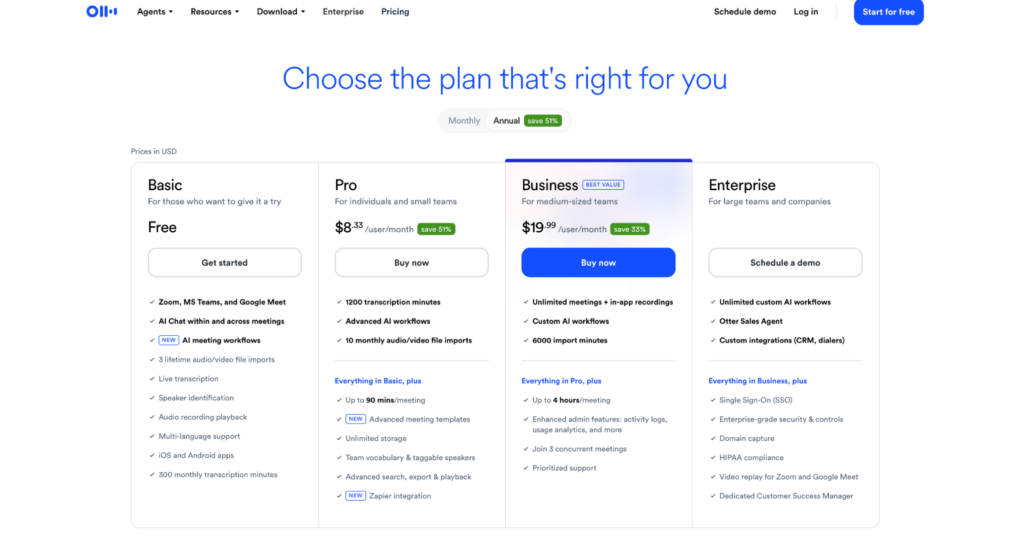
FastSpring provides a wide variety of subscription management tools to help you monetize your mobile app, game, software as a service, or other digital products.
Items and Upgrades
Items and upgrades are yet another packaging option for monetizing your app. These can be independent of other options like subscriptions and in-app currency, or they can work in tandem with them.
In the case of Otter, which offers a freemium version of their service (either via web or using their app), upgrades such as more transcription minutes, team collaboration, and advanced export options help incentivize users to subscribe to their Pro and Business packages.
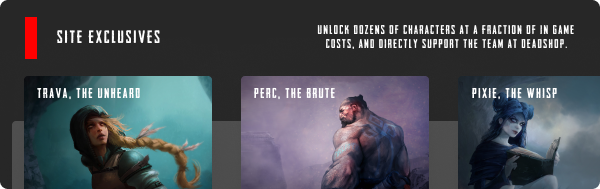
In the case of gaming apps, the possibilities are nearly endless — with exclusive items, characters, power-ups, and more to motivate players to shop via the website and redeem in the app.
Legal and Regulatory Updates Regarding App Sales and Monetization
If you’re not familiar with the recent and ongoing legal challenges that could affect both Google and Apple’s stores in some way, there have been quite a few around the world, including in the U.S., Europe, Japan, and Brazil.
The EU’s Digital Marketing Act (DMA)
In Europe, the EU’s Digital Marketing Act (DMA) is aimed at what the Commission called “gatekeepers” (which includes Apple, Google, Meta, etc.), and the Commission began enforcing it in March 2024.
Apple has revised its App Store rules, giving developers more freedom and flexibility when it comes to monetizing — but this was after the company was charged with violating the DMA rules by not fully allowing steering.
Get the basics on the DMA and more helpful links here.
Japan’s Mobile Software Competition Act Guidelines
The Japan Fair Trade Commission (JFTC) released the Mobile Software Competition Act Guidelines, which includes regulatory guidance in line with the EU’s DMA. The MSCA guidelines went into effect in December 2025 and address Apple and Google’s restricting of alternative app marketplaces, forced use of their own payment systems, and anti-steering & browser engine restrictions.
Epic Games’ Lawsuits in the US
After Epic Games used discounts to encourage its Fortnite users to use a different payment system instead of the app marketplaces, both Apple and Google subsequently removed Fortnite from their stores in 2020. Epic Games then separately sued both Apple and Google.
In the Apple case, judgments and appeals have been split between Epic and Apple. Of note, the 9th Circuit U.S. Court of Appeals ruled in April 2023 that Apple’s prohibition against allowing app devs to send users to other non-App Store payment methods violated California’s Unfair Competition Law.
Appeals were made to the Supreme Court, but in January 2024, the Supreme court decided not to hear those appeals; read more about responses from Epic and Apple here.
In response to requirements that the company permit developers to guide users toward alternative payment options outside the App Store (also known as “payment steering”), Apple put in place rules that required developers to report — and pay Apple a commission — on transactions processed elsewhere. But n April 2025, a U.S. judge ruled against Apple, preventing the company from charging commissions on external payments.
In the Google case, appeals also continue, but a December 2023 ruling found in favor of Epic on all counts, and the U.S. Supreme Court ruled in October 2025 against Google’s bid to delay required changes to the Play Store set to take effect later that same month.
Disclosure: FastSpring provided key evidence about alternative payment options in EPIC’s antitrust lawsuit against Google. Read more here.
US State-Led Cases
In Utah v. Google, 37 attorneys general (representing 21 million Americans) maintained that Google uses illegal, anticompetitive, and/or unfair business practices that restrict competition, drive up prices, and limit choices, all of which harm consumers that purchase games and other digital goods through the Google Play store. Read more about the Google case here.
Brazil’s Antitrust Regulation
After a 2022 complaint filed by MercadoLibre in both Brazil and Mexico — in which MercadoLibre took issue with Apple’s requirement that app developers must use Apple’s payment system for selling digital goods or services offered within the apps — Brazil’s antitrust regulation agency Cade stated in Nov. 2025 that Apple needed to lift restrictions regarding payment methods for in-app purchases. That included allowing links to other sites to help facilitate alternative payment options.
Frequently Asked Questions About Selling Outside the App Stores
Publishing an app on the Apple App Store requires you to maintain an Apple Developer Program membership, which costs $99 per year (even if you don’t plan to monetize your app). If you monetize your app — and you opt to let Apple handle the sale — the company charges commissions of 15-30% of your sales.
This is a complex and evolving situation. After various regulators around the world began requiring Apple to allow developers to link users to external payment options, Apple implemented new rules requiring developers to report those external sales and still pay a (slightly smaller) commission.
In April 2025, a U.S. judge ruled against Apple’s ability to charge developers for external payments, but the precise legal landscape around this continues to change.
While we’ve focused primarily on monetizing outside the app marketplaces (in other words: selling D2C via your website), the rules for distribution are also changing.
In Europe, regulations like the Digital Marketing Act (DMA) are beginning to force platforms like Apple to allow for alternative app marketplaces and distribution methods. That said, for most developers, the strategy is still to distribute through the large app stores while monetizing outside of them.
By selling direct, you can avoid the steep 15% to 30% commission fees charged by the Apple App Store and Google Play Store. Selling directly can help increase your profit margins and/or pass savings on to your users by offering discounts for purchases made on your website.
It also gives you improved access to customer data and insights, more control over pricing and promotions, better brand visibility and loyalty, and more. See more reasons why game publishers are already using D2C in our survey results.
Partner With FastSpring
If you’re looking for help selling your mobile app or video game directly to consumers, we can help.
FastSpring powers global D2C payments for game studios and app publishers. As a merchant of record, we provide a fully managed payment solution — including customizable checkout, fraud mitigation, and 100% automated sales tax and VAT compliance.
Interested? Set up a demo or try it out for yourself.
Thanks to Tony Markov for contributing to this article!
This post was originally published in Feb. 2024 and has been updated.