








 Buyer Support
 Seller Support


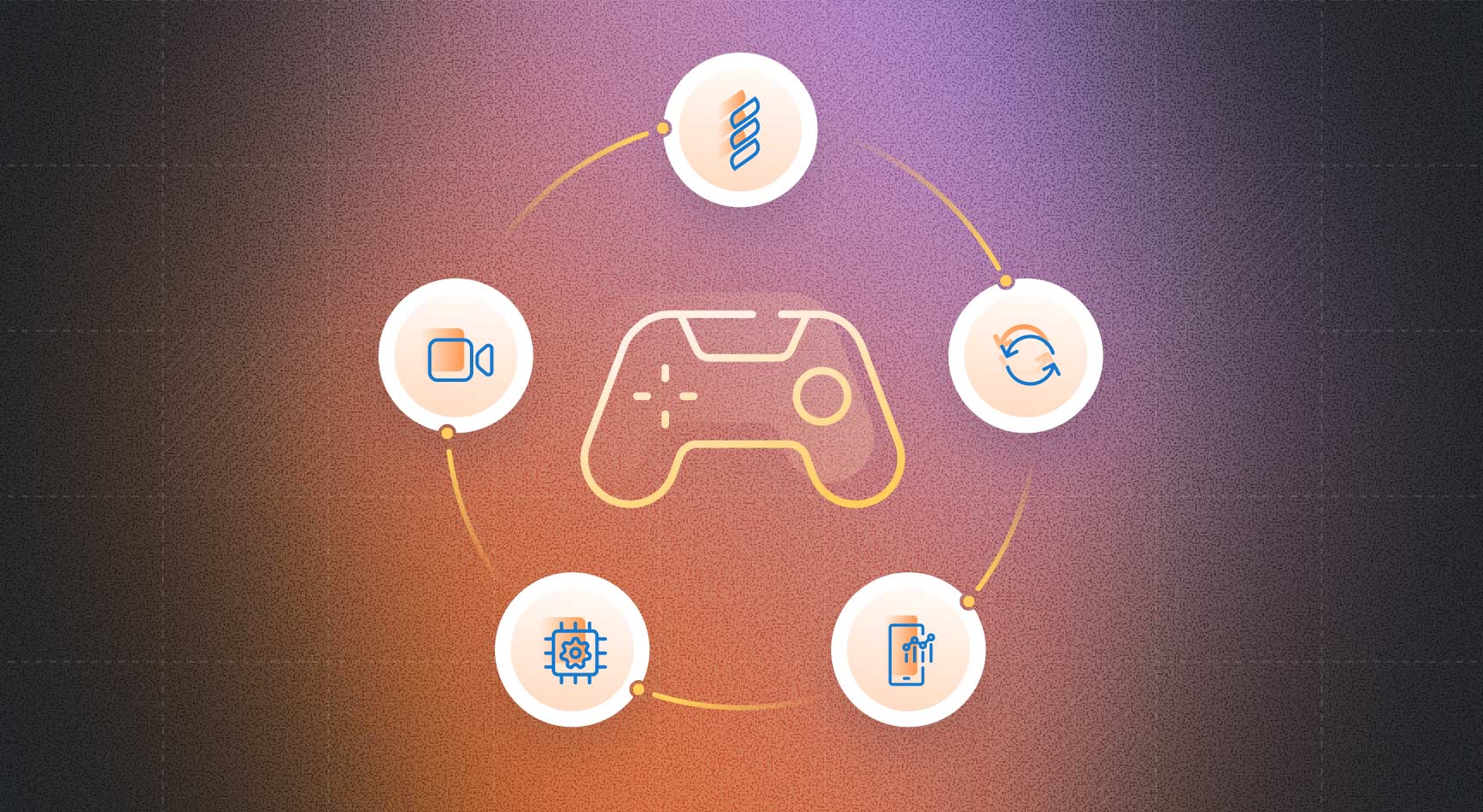
The always-growing list of new technologies that games publishers can utilize may seem never-ending, but we’d like to help you narrow it down to some of the most impactful options.
Between regulatory changes reshaping mobile monetization, a renewed appetite for creator-powered marketing, and developers taking a harder look at the tools they build with, gaming publishers have to navigate a genuinely exciting — and genuinely demanding — technology landscape here in 2026.
Everyone’s already talking about AI, so we won’t cover that here. Instead, we’re talking about five new and emerging technologies gaining real traction with gaming publishers today:
- A D2C payments partner.
- Content creator platforms.
- Mobile measurement partners (MMPs).
- Alternative game engines.
- Next-gen live ops.
Spend less time managing your payments and compliance and more time making great games. FastSpring is a payments partner you can trust to help you sell games or in-game items on your website, web store, or embedded in-game with fully customizable and branded checkouts. We allow you to offload the complexity of global payments, sales tax and VAT compliance, player payments support, and more. Set up a demo or try it out for yourself.
1. A D2C Payments Partner
Direct-to-consumer (D2C) monetization is relatively new in the grand scheme of things, but it’s been around for years and is poised to grow even more in 2026.
According to a survey FastSpring conducted with Omdia in 2025, 96% of those who weren’t yet doing D2C planned to implement it — and 60% of them planned to do so within the next 12 months.
Some publishers want better access to first-party player data; others want more control over pricing and promotions. Some are just looking to mitigate the chunk of revenue lost to mobile marketplace fees, which hover around 15%-30%.
Regardless of the motivation, going D2C can dramatically improve your margins while strengthening the direct relationship with players.
Of course, standing up a D2C (also called app2web) operation comes with its own challenges: payment processing, tax compliance in multiple jurisdictions, fraud prevention, localization, and more. That’s where your choice of game payments partner matters — and specifically, the choice between a payment service provider (PSP) and a merchant of record (MoR).
An MoR Is the Better Choice for D2C Gaming Publishers
A PSP such as Stripe helps you accept payments, as does an MoR (such as FastSpring).
But an MoR also becomes the entity making the sale on your behalf. That means the MoR absorbs the liability for global sales tax and VAT compliance, chargebacks, and regulatory requirements across every jurisdiction you sell in.
That’s a meaningful distinction when you’re selling to players in multiple countries and don’t have an in-house tax team (or the budget for one) to manage all the complexity.
FastSpring’s MoR model supports the most popular payment methods in 240+ countries and regions, handles checkout and payment localization, and integrates with custom web stores through our JavaScript Store Builder Library (SBL) — meaning players stay in a familiar, branded checkout experience, even as FastSpring handles everything behind the scenes.
Plus, we offer easy-to-use and innovative approaches such as Steer Safe™ that make it simple to deliver fast and frictionless paths for your players to make D2C purchases.
In other words: FastSpring focuses on the selling, so you can focus on building great games.
If you’re looking for help selling your mobile video game or app direct to consumers, we can help. FastSpring powers global D2C payments for game studios and app publishers. As a merchant of record, we provide a fully managed payment solution including customizable checkout, fraud mitigation, and 100% automated sales tax and VAT compliance. Interested? Set up a demo or try it out for yourself.
2. Content Creator Platforms
Word of mouth has always mattered in gaming, but the way it works has fundamentally changed as social platforms have emerged and evolved. Streamers, YouTubers, and short-form video creators are now among the most influential discovery channels in the gaming industry, a trend that’s only accelerating. Publishers who haven’t formalized their approach to creator partnerships are increasingly at a disadvantage.
Platforms such as Nexus are designed specifically to help gaming publishers manage and scale creator relationships. Nexus powers creator programs for game developers — think of it like an infrastructure layer for running a support-a-creator ecosystem.
Creators can drive traffic to a publisher’s web store, bypassing the app store entirely, which sidesteps a lot of the anti-steering complexity that has made in-app creator programs tricky on iOS and Android — particularly in regions where Apple and Google still severely restrict game to web steering.
FastSpring’s partnership with Nexus offers publishers a done-for-you web store — custom-designed and player-optimized — with FastSpring’s global payments and compliance infrastructure already baked in. Nexus handles the creator layer, and FastSpring handles the payments layer.
3. Mobile Measurement Partners (MMPs)
Mobile measurement partners (MMPs) are third-party attribution platforms that aggregate data across ad networks, channels, and campaigns to give you a holistic and comprehensive view of what’s actually driving game downloads, in-app purchases, and revenue.
It’s a simple concept, but a complicated task. Every ad network has an incentive to claim credit for your conversions. Without a neutral third party making the attribution call, your reporting is always going to skew toward over-counting. AppsFlyer explains that an MMP acts as an impartial referee.
These are some of the major players in the MMP space, and they each have unique strengths:
- AppsFlyer leads on global scale and fraud prevention.
- Adjust is widely respected for real-time analytics.
- Singular has carved out a strong position by combining attribution with spend data in a single dashboard, making ROI analysis easier than ever.
- Kochava appeals to data-heavy teams that want full ownership over their raw attribution data.
- Branch specializes in deep linking and web2app flows.
MMPs can be a crucial strength when it comes to D2C monetization, too. A web store running on a platform such as FastSpring generates its own purchase data — being able to reconcile that data with your mobile app gives you a much more complete view of the player journey, from acquisition through to purchase, across every channel.
4. Alternative Game Engines
For years, Unity and Unreal Engine defined the game engine landscape. That’s still largely true, but the industry is shifting toward more diversified options.
Recap on the Big Two: Unity and Unreal Engine
They’re the big ones you already know, but here’s a quick refresher:
Unity
Unity is one of the most widely used engines in the industry, particularly for mobile and indie development.
That said, its reputation took a significant hit in September 2023 when it announced a runtime fee that would charge developers a small amount per install after certain revenue and download thresholds — including, controversially, reinstalls and pirated copies. The backlash was swift and widespread.
Under sustained pressure, Unity eventually reversed course a year later, but the episode kickstarted demand for alternative game engines — with many studios now deliberately cross-training their teams on other engines as a hedge against future surprises.
Unreal Engine
Unreal Engine (from Epic Games) is particularly dominant in high-fidelity 3D and AAA development, and its royalty model — 5% of revenue above $1 million for any game — has remained stable and predictable (in contrast to the Unity controversy).
Unreal Editor for Fortnite (UEFN) is also expanding Unreal’s footprint into the user-generated content space, giving creators tools to build within Fortnite’s ecosystem.
Alternative Game Engine Option: Godot
Godot, an open-source and free 2D/3D engine, had been in community-driven development since 2014 when its 4.0 release landed in March 2023 — just a few months before the Unity runtime fee controversy sent developers looking for alternatives.
Godot saw a massive influx of interest following the Unity backlash, with developers who’d spent years in Unity arriving to find a surprisingly capable engine backed by a patient, community-first culture. Godot excels at 2D development and stylized 3D, though it doesn’t yet match Unity or Unreal for photorealistic AAA visuals.
For indie studios and smaller teams that don’t need that level of graphical fidelity, it’s become a genuinely compelling option — particularly given that it’s completely free.
Other Rising Game Engines Worth Watching
A few other engines are gaining traction in specific niches, too.
- Bevy (Rust-based, open-source) appeals to developers who want modern performance guarantees and a data-driven architecture.
- Defold, maintained by King and the Defold Foundation, is free and optimized for 2D games.
- Cocos is especially popular in the Asian mobile market.
While none of these are likely to displace Unity or Unreal at scale, they’re part of a broader diversification of the engine ecosystem that publishers should be aware of when evaluating their development stack.
5. Next-Gen Live Ops
Live ops — such as ongoing events, limited-time content, seasonal passes, and real-time player engagement systems — isn’t a new concept. Studios have been running live services for over a decade. And seasonal events and live ops are projected to make up a very significant portion of in-app purchase revenue in 2026 regardless of exactly which metric you look at.
What’s changed is the sophistication and intentionality with which top publishers are approaching live ops in 2026. There’s been a shift from thinking of live ops as a bolted-on afterthought, to viewing it — and treating it — as a core part of the product.
That’s the key shift: No longer a post-launch afterthought, live ops are built right into product roadmaps from day one, with the dedicated teams, tooling, and data infrastructure it needs to support it.
What do next-gen live ops actually look like? A few things stand out:
- For casual and puzzle games: Seasonal album mechanics — such as when players collect themed card sets through regular gameplay — have become a standard format for stretching engagement over weeks without disrupting core loops. Royal Match and Monopoly GO have demonstrated how well this works when executed with the right pacing and reward structure.
- For midcore and RPG titles: The dominant structure is a rotating “activity spine” — weekly PvP seasons, challenge hubs, and limited-time modes that bundle currencies, progression, and content into evolving loops.
Battle passes have become a fixture across genres precisely because they solve a specific problem: giving players a clear sense of forward progress during the stretches between major content releases. When done well, they function less like a monetization mechanism (more on that below) and more like a roadmap — players know what they’re working toward and why it’s worth coming back.
Personalization is also becoming a real differentiator here. Instead of traditional static segmentation, publishers can now implement more dynamic systems that respond to individual player behavior — adjusting offers, event timing, and content visibility based on how a given player actually engages.
The caveat, particularly in PvP-leaning games, is that monetization managers should be cognizant about when personalized mechanics impact gameplay advantage, as this can be a very sensitive area for players. The safest applications are:
- Offer timing.
- Cosmetic rewards.
- Difficulty calibration.
A quick word of caution here: The player community has big opinions about all of this. There’s a not-insubstantial subset of players — particularly in the hardcore segment — who see live service mechanics as synonymous with predatory monetization.
The distinction between engagement-first and monetization-first design is real, and players feel it. Studios that navigate this well tend to do a few things consistently:
- Roll out changes in stages.
- Communicate clearly about what’s changing and why.
- Avoid invalidating past player investment.
Partner With FastSpring
Whether you’re just starting to think about a D2C web store or you’re ready to optimize an existing one, FastSpring gives you the payments infrastructure to make it work — without having to manage global tax compliance, fraud prevention, or player payments support in-house.
For over two decades, FastSpring has been a payment provider you can use to sell apps, games, or in-game items on your website, web store, or embedded directly into your app with fully customizable and branded checkouts just for you. FastSpring allows you to offload the complexity of global payments, sales tax and VAT compliance, player payments support, and many other aspects of payments management.
Spend less time managing your payments and compliance and more time making great games! Set up a demo or try it out for yourself.