












Key Takeaways About App2Web Mobile Monetization:
- App2web flows enable mobile app and mobile game developers to steer users to their own external web store to complete transactions outside the “walled gardens” of Apple’s App Store and the Google Play Store.
- Doing so allows developers to avoid hefty commissions paid to app stores — but also to more directly own their relationship with users and gather invaluable first-party data.
- Steer Safe™ from FastSpring offers a quick, simple way to launch app2web with secure, localized checkout and the most popular global payment methods.
For over a decade, the mobile app economy was defined by the walled gardens of two tech behemoths: Apple’s App Store and the Google Play Store. For developers of digital-first businesses — including mobile apps and mobile games — hefty commission fees of 15% to 30% were par for the course, a necessary evil to gain access to these marketplaces and consumers who frequent them.
Today, that’s changing. A series of landmark legal rulings and shifting regulations around the world are breaking down those walls, making mobile monetization outside of app stores possible and offering developers a way around those hefty fees.
App2web flows, which steer users from within an app to your external web store to complete a purchase, are a big part of that.
Below, we cover:
- The regulatory and legal landscape — and why app2web is emerging now.
- The benefits of app2web.
- A step-by-step guide to launching app2web in the U.S.
- In-app steering with Steer Safe™ from FastSpring.
- How to leverage your App2Web first-party data.
- How to monetize with web2app in addition to app2web.
- Creating one connected commerce experience with FastSpring.
- Frequently asked questions about mobile app app2web monetization.
Prefer to watch a video presentation about app2web monetization? Our experts presented an earlier version of this content at a Business of Apps event in Oct. 2025. Watch the full video here.
FastSpring is how gaming studios and mobile app makers sell in more places around the world. For over two decades, FastSpring has been a payment provider you can use to sell apps, games, or in-game items on your website, web shop, or embedded directly into your app with fully customizable and branded checkouts just for you. FastSpring allows you to offload the complexity of global payments, VAT and sales tax compliance, player payments support, and many other aspects of payments management. Spend less time managing your payments and compliance and more time making great apps! Set up a demo or try it out for yourself.
The Shifting Regulatory Landscape Around App Stores and Mobile Monetization
The transition to web-based monetization is powered by a number of legal decisions that have redefined what steering looks like for mobile developers. These rulings have effectively legalized and protected the practice of guiding users to a website to find a better deal or additional options.
- Epic v. Apple (U.S.): In April 2025, rulings established that Apple cannot prevent iOS developers in the United States from including links in their apps that direct users to an external website for payments. Further decisions clarified that Apple cannot charge developers commission fees on external purchases made outside the App Store.
- Epic v. Google (U.S.): Similar steering capabilities for Android apps in the United States became available in late 2025 after the U.S. Supreme Court denied Google’s request for a stay on the deadline to open the Google Play Store to alternative options by October 22, 2025.
- Japan’s Mobile Software Competition Act: This regulation, which went into effect in December 2025, unlocks steering on both iOS and Android platforms for developers in the Japanese market.
These changes mean that, for the first time, you can explicitly message users in-app about better deals or exclusive content available on your own web store without fear of account suspension.
Why Go App2Web? (Hint: It’s About More Than Fees)
While saving on marketplace commissions is a significant driver, they aren’t the only reason top-tier developers want to sell outside app stores. In a 2025 survey of mobile gaming companies, top reasons for adopting a direct-to-consumer (D2C) web store included:
- Improved access to customer data and insights.
- More control over pricing and promotions.
- Improved brand visibility and loyalty.
- The opportunity to build a direct relationship with players.
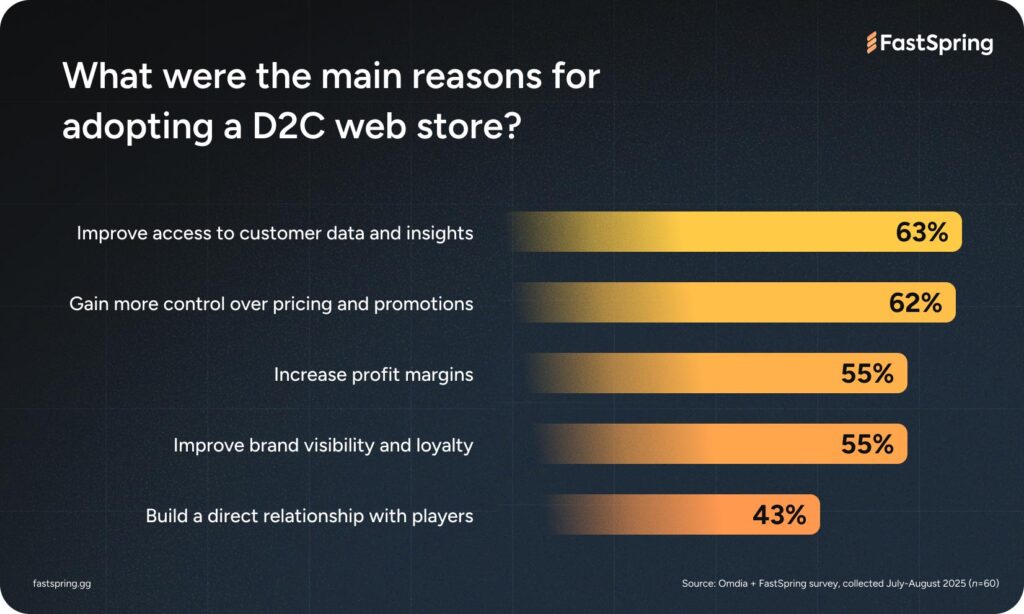
Read the results of our entire gaming industry survey here.
The Value of First-Party Data
When a user transacts through a traditional app store, the marketplace owns the relationship, often providing the developer with anonymized data only. By moving the transaction to your web store, you capture the most valuable piece of data for any business: the customer’s email address.
Having direct access to user data — including geography, platform, language, name, and purchase history — allows you to move from reactive to proactive marketing. You can implement automated onboarding flows, renewal reminders, and win-back campaigns to enhance adoption, promote loyalty, and mitigate churn.
Solving the Attribution Gap
One of the greatest challenges in mobile marketing is the attribution gap created by walled garden ecosystems. Web stores allow you to embed tracking pixels from platforms such as Meta and Google — so you can see exactly which ad campaigns drive paid conversions, rather than just app installs.
This feedback loop is essential for optimizing your ad spend, allowing you to double down on high-performing campaigns and create lookalike audiences based on your best customers.
Pricing and Bundling Flexibility
The web offers freedom and flexibility that app stores just can’t match. On your web store, you can experiment with tiered pricing, custom bundles, or loyalty rewards, with no requirement that they fit into Apple or Google’s rigid SKU structures.
For example, you might offer a “Buy Direct” bonus, such as offering a discounted subscription or a month of free service, to incentivize the jump to your web store.
How to Launch App2Web in the US
Launching app2web monetization doesn’t require building a massive ecommerce platform. You can start with a simple, secure checkout loop that integrates with your existing back-end systems.
Step 1: Add In-App Buy Buttons
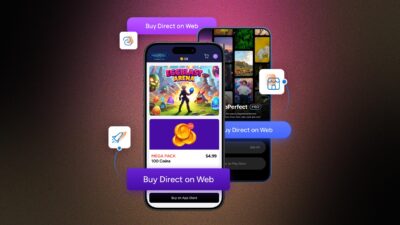
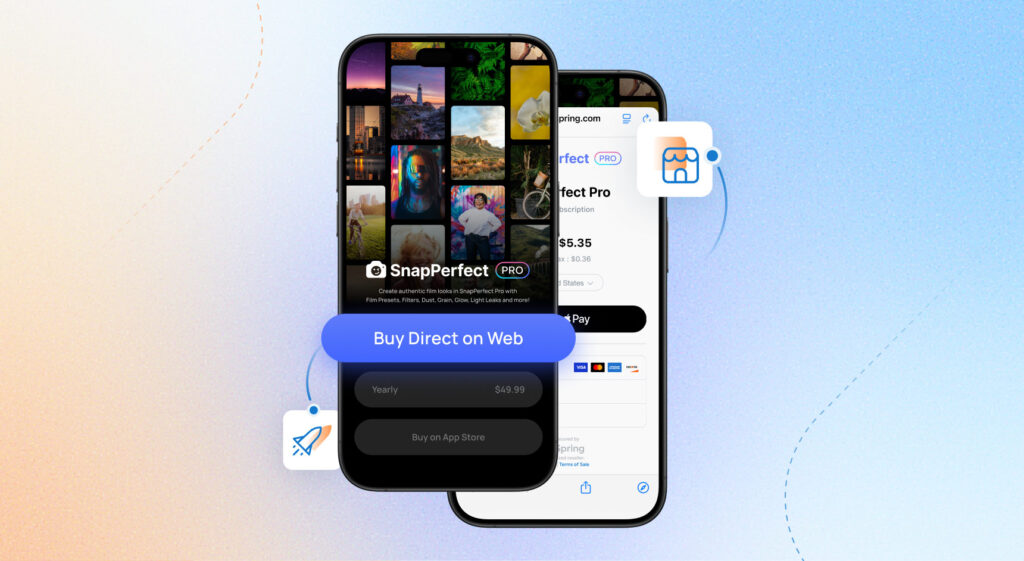
Place clear calls to action (CTA) buy buttons in appropriate places within your app or game — such as your paywall, your in-game store, or a settings menu — that link to your checkout experience or web store.
In the U.S., you can use explicit messaging such as “Buy direct and save” to guide users.
Step 2: Pass Dynamic URL Variables
To ensure the transition is seamless, your app needs to pass data over to your web store. When a user taps the Buy button, use dynamic URL variables to pass their User ID, product tokens, and authentication details to the back-end system.
This allows your web store to recognize the user instantly without requiring them to log in again and adding unnecessary friction to the checkout process. It helps you track who that person is, what they’re doing, and their entitlements.
Then you can use that data to leverage segmentation, for example, or to offer promotions or discounts as related to that user.
Step 3: Localized Web Checkout
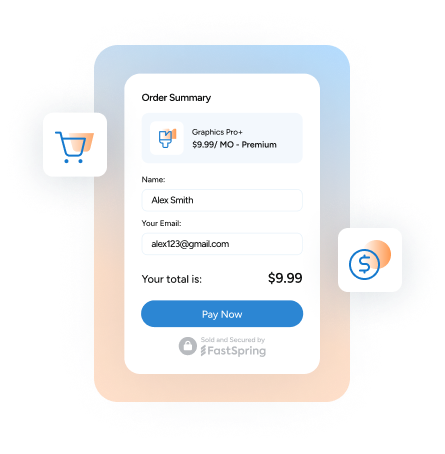
With web checkout, you can control the design, data collection, and payment methods you accept. It doesn’t have to be complicated — it can be as simple as your logo, the product they’re purchasing, and the payment methods offered.
It’s crucial to offer localized payment methods that are familiar to your users in different jurisdictions. For example, U.S. users are familiar with mobile wallets such as Apple Pay and Google Pay, which offer quick, seamless checkout for them. In Brazil, users may prefer Pix, while in India, UPI (Unified Payments Interface) is more popular.
Beyond payment methods, your web checkout may also need to be translated into other languages and prices converted into the user’s currency.
Step 4: Communicate With Back-End Systems to Allow In-App Entitlements
Once the purchase is complete, your commerce platform sends a signal — typically via a webhook or API — to your back-end.
Your internal systems then update the user’s account and unlock the digital product or subscription. At the same time, a deep link redirects the user back to your app, where the purchase is reflected in near real-time — as few as 10-15 seconds.
In-App Steering With Steer Safe™ From FastSpring
In addition to circumventing app store fees and collecting user data, another key goal of the flow is driving value for your users. That means creating a smooth, secure loop where the user finishes their checkout on the web, your systems automatically sync, and the app reflects the purchase in near real-time.
If all of that sounds a bit complicated to pull off, FastSpring can help. Our approach to app2web steering — called Steer Safe™ — makes it simple for you to steer users from in-app experiences to secure, localized checkout, and back to your app, all in a matter of seconds. It’s a much faster and easier way to deploy app2web as soon as possible.
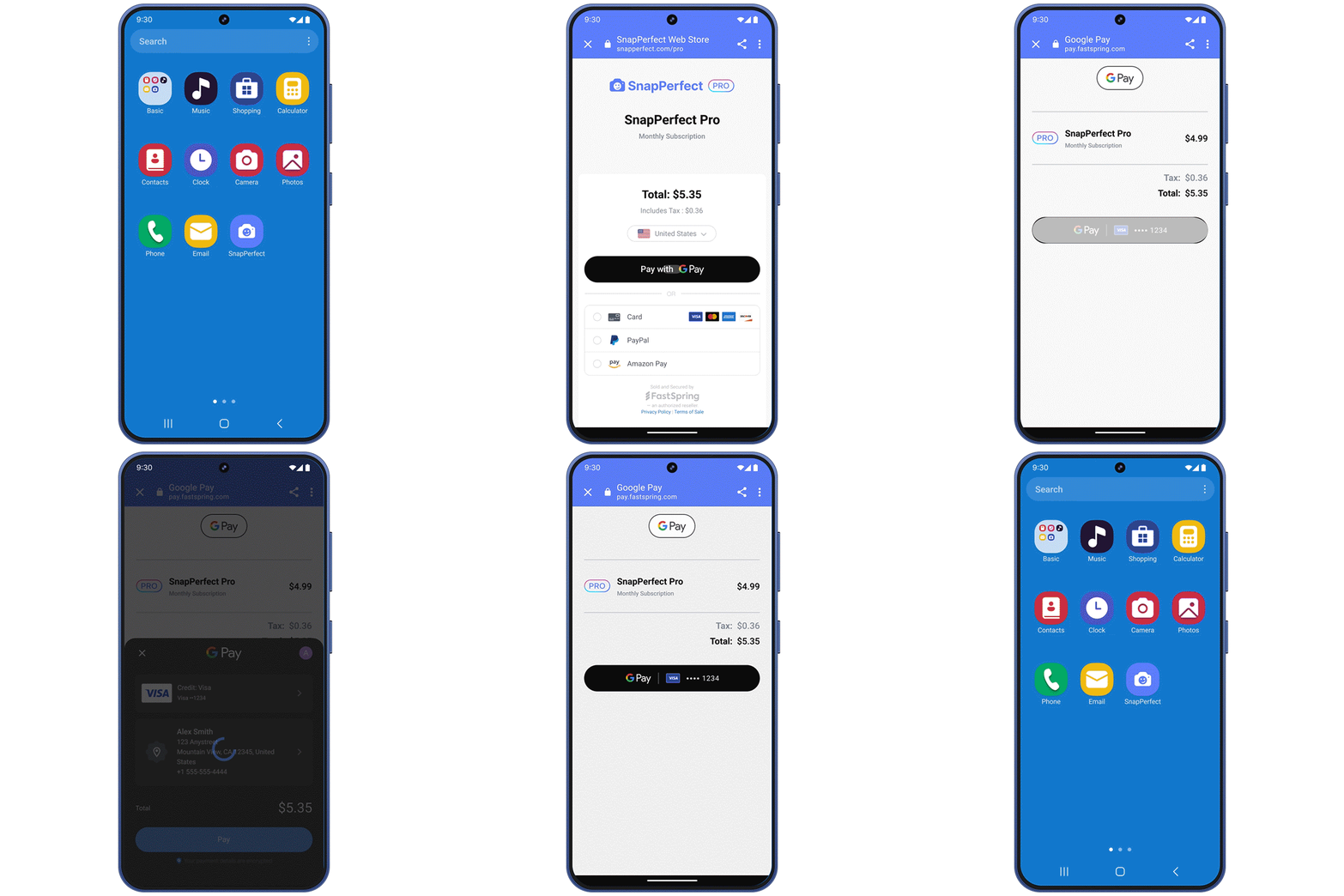
It’s back-end agnostic — meaning it works with whatever back-end system you’re using — and is available for both iOS and Android mobile apps.
Learn more about Steer Safe™ from FastSpring.
Leveraging Your App2Web First-Party Data
When you’re just operating in app stores, it can be very challenging to identify who your users are, collect their email addresses, and create a conversation with them. By using the app2web flow, you unlock a lot of that data.
Once you’ve established that direct line to your customers through your web store, you can transform your growth strategy from generic to highly personalized.
Ad Targeting and Retargeting
With a web store, you’re no longer flying blind. By connecting your first-party data to your ad platforms, you can:
- Identify high-value campaigns: Know which creative assets and which audiences are driving the most revenue.
- Automate targeting: Ad platforms like Google and Meta can automatically use this data — along with their own algorithms — to better target your ads to the users most likely to convert.
- Effective retargeting: Show ads specifically to users who visited your web store but didn’t complete a purchase.
- Build “lookalike” audiences: Upload your list of converted web buyers to find new users with similar characteristics.
Email Marketing
Your email list is your most direct channel for retention, and — as we mentioned above — email addresses are the most valuable piece of data you can collect via app2web.
When you connect this and other first-party data to your email marketing platform, you can easily tailor and target your email campaigns.
- Personalized onboarding: Send tutorials and tips based on the specific product or bundle they purchased.
- Automated renewals: Remind subscription users of upcoming renewals with a link to manage their account on the web.
- Win-back and re-engagement flows: If a user hasn’t logged in for 30 days, trigger an email offer with a web-exclusive discount to bring them back.
- Segmentation: Segment users to deliver the right message, to the right people, at exactly the right time.
Monetizing With Web2App In Addition to App2Web
Whether you’re in a region where app2web isn’t allowed, or you simply want to improve revenue and user acquisition, web2app is a valuable addition to your toolbox.
This flow creates a funnel through which you can drive user acquisition, and helps avoid fees on the app store. To do this, you’ll need a few parts: social ads or organic posts, a website landing page, and a checkout.
Instead of using the app store as your primary user acquisition channel, you can leverage paid social platforms like Meta, TikTok, or Google Search to send traffic directly to your website. Instead of being reliant solely on the app store listing, you can take ownership of the entire user journey.
When a user clicks on an ad, they land on a high-converting page you’ve designed without the distractions — or limitations — of the app store pages. This also allows you to implement other features like robust A/B testing, pixel tracking, and retargeting strategies that contribute to additional access to user data.
Then at checkout, you gain the benefit of bypassing the standard 15%-30% platform commissions and can offer features on your site that decrease customer churn, such as saved payment methods and account management. You can also offer flexible pricing, bundle products, or discounts that wouldn’t be otherwise feasible if you were paying the cut to the app store.
Once the transaction is finished, you’ll send your user to an app store page link to download and log in, where their purchase is already waiting for them.
Ultimately, this strategy transforms your app from a discovery-dependent product into a conversion-focused powerhouse, where you’re able to control user acquisition from channels outside of the app marketplaces while still keeping the flows that already work for you.
Other Web2App Tips
Funnels aren’t the only way you can improve user acquisition on your website with web2app. Below are a few more tips for how you can use it to improve website conversions and user acquisition:
Incentivizing the Web Visit
To encourage users to leave the app and visit your site, offer additional value that isn’t available in the mobile app interface:
- Additional free assets: Templates, PDFs, exclusive in-app themes, or resource libraries.
- Industry content: Educational content, industry insights, and tutorials.
- Site-exclusive events: Webinars, livestreams, Q&As, or site-exclusive challenges.
- Community: Forums, community showcases, leaderboards, etc.
- Loyalty rewards: Badges or loyalty currency for in-app purchases.
- Reports and tracking: Exportable data summaries and personalized dashboards.
How to Launch Web2App Store Flows
- Create a product page with the products available to purchase for your customers. If you only offer a single product, this can be a single, simple page. For more extensive product catalogs, a full web store may work better.
- Integrate the checkout experience into your product page as a simple pop-up checkout, for example, or a more customizable embedded checkout. A shopping cart feature may be worthwhile if you offer many products or add-ons.
- Process user payments on your web store using Apple Pay, Google Pay, and other popular, preferred, and localized payment methods, depending on the jurisdictions where your users live.
- Communicate with back-end systems via webhooks and APIs to allow in-app entitlements — confirm purchases, deliver subscriptions, unlock content, etc. — and send users back to the app as quickly as possible following a purchase.
When done well, checkout should feel like a part of a more holistic experience that users have with your brand. Ensuring the process is seamless and quick — and that the design is consistent across your app, web store, and checkout flow — will help guide users through the payment process and mitigate any drop-off or abandonment.
One Connected Commerce Experience With FastSpring
App2web isn’t a standalone channel or strategy. Think of it more like an additive layer to your existing app and web strategy.
Together, app2web and web2app flows unlock new revenue and richer first-party data. It’s not just about billing, but about developing a direct relationship with your users.
The question is no longer whether you should launch direct monetization on your website, but how quickly you can get it live to start owning your customer relationships. With FastSpring, it’s easier than ever to connect app2web and web2app flows to your app, helping you convert more, everywhere.
FastSpring is how gaming studios and mobile app makers sell in more places around the world. For over two decades, FastSpring has been a payment provider you can use to sell apps, games, or in-game items on your website, web shop, or embedded directly into your app with fully customizable and branded checkouts just for you. FastSpring allows you to offload the complexity of global payments, VAT and sales tax compliance, player payments support, and many other aspects of payments management. Spend less time managing your payments and compliance and more time making great apps! Set up a demo or try it out for yourself.
Frequently Asked Questions About App2Web Monetization for Mobile Developers
What Is App2Web and How Does It Benefit Mobile Developers?
App2web flows enable mobile app and mobile game developers to steer users to their own external web shop to complete transactions outside the walled gardens of Apple’s App Store and the Google Play Store.
Benefits for developers include:
- Improved access to customer data and insights.
- More control over pricing and promotions.
- Improved brand visibility and loyalty.
- The opportunity to build a direct relationship with players.
Can I Steer iOS and Android Users to My Web Store?
As of this writing, direct and explicit steering is allowed for users in the U.S. and Japan.
For users outside these jurisdictions, developers can deploy web2app flows: Instead of linking directly to a payment page, you can steer users to non-payment pages — i.e., pages that provide some non-transactional value.
It’s less direct, but this strategy works as a one-two punch: you bring them to the web for content, and once they have an account, you can market the store to them directly.
Ready to try FastSpring? Set up a demo or try it out for yourself.