








 Buyer Support
 Seller Support


For more than a decade, mobile apps worked under a simple deal with app marketplaces. Give up 15-30% of each transaction, and in return the store handles your payments and puts your app in front of millions of potential users.
That’s changed with the advent of AI-assisted development. Now, it’s easier than ever to build, so app marketplaces are more crowded than ever and organic discovery through ASO is harder. Publishers have shifted budget to paid acquisition on Meta, TikTok, and Google. But platform privacy rules make it difficult to tie results to individual campaigns.
The result is that many subscription apps pay a marketplace commission on customers they found and paid for themselves once they buy a subscription. They also give up direct access to those customers’ data. Once a subscriber churns, there’s no way to reach them.
Direct monetization changes that. It means selling subscriptions through your own web funnel and checkout, alongside your in-app purchases, not instead of them. App marketplaces still produce meaningful revenue, and some users will always prefer to buy there. A direct channel adds what the stores can’t: lower fees, first-party data, and control over pricing, packaging, and retention.
There are two ways to build a direct channel, and they reach different users:
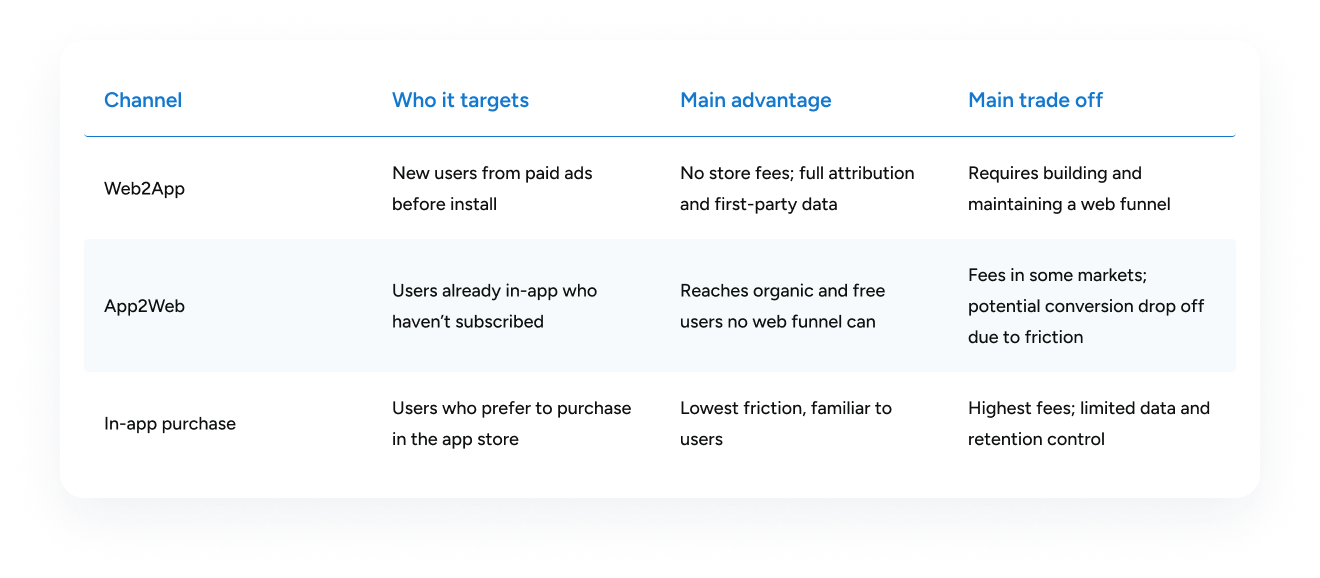
- Web2App acquires new users on the web, before they ever install your app.
- App2Web lets users who are already in your app be sent to your site to purchase their subscription.
This article covers how each works, what the fee math looks like, where the rules stand today, and how to choose the right mix for your apps.
Web2App: The Funnel You Fully Own
A web2app funnel sends users from an ad on Meta or Tiktok to a web onboarding flow, usually a short quiz ending in a personalized paywall. Users subscribe, optionally buy an upsell, and are then sent ot hte App Store or Google Play with their subscription already active.
Because the purchase happens before the user reaches a store, web2app sits entirely outside app marketplace rules around steering and payment attribution. It’s the same principle streaming services like Netflix and Spotify have long relied on: subscriptions bought on the web aren’t subject to store commission. If you paid to find the customer and built the funnel that converted them, you keep the revenue.
The fee savings are real, but they aren’t the only benefits.
Attribution You Can Act On
A web funnel is a website, so you can use pixels and server-to-server integrations with ad networks. Every campaign, ad, and creative can be tied to a real subscriber, and the signal arrives within hours instead of days of aggregated platform reporting. That lets UA teams optimize faster and on smaller budgets.
Higher Conversion From Ad Click to Purchase
Teams often assume a web funnel will cost them conversions. Third-party research found the opposite: measured from ad click to purchase, web2app funnels converted at roughly twice the rate of in-app funnels and produced higher LTV according to FunnelFox.
The reason is where measurement starts. In-app funnels are usually measured from the first onboarding screen, which hides the biggest drop-off: the store listing. A web funnel skips that step. It continues the story the ad started and builds commitment through personalization before the user sees a paywall.
Retention Levers You Control
The stores offer some retention tools. Google Play supports subscription pauses, and Apple supports win-back and promotional offers. But the store decides when and how those appear, and many cancellations happen in a system prompt when a user deletes their app.
On the web, you own the cancellation flow. You can offer a pause, a downgrade to a cheaper tier, a win-back discount, or a longer plan at a better rate. And if a subscriber does churn, you still have their contact details for future win-back campaigns.
Pricing and Packaging on Your Terms
In-app and web prices are now roughly the same according to FunnelFox’s research. Web2app users often never see the in-app price, so there’s no race to the biggest discount.
The real advantage is flexibility and speed. Both stores support introductory offers, but on the web you can test structures freely without waiting on store review. Common patterns include paid trials, where a user pays $1-3 for a seven-day trial before the full plan starts, and plan ladders from a one-week trial into monthly, quarterly, and annual options.
The Fee Math Compounds With Every Renewal
App marketplace commissions typically run 15-30%, depending on platform, program, and how long the subscriber has been with you. At a small scale, that’s a cost of doing business. At a larger scale, it’s a meaningful share of revenue.
Consider an app earning $10M a year in subscription revenue at a blended commission of about 20%. It pays around $2M a year to the marketplaces. Now suppose its direct channels grow until 30% of that revenue, or $3M, comes from subscribers acquired on the web. Those apps keep $360-450K more than through the stores alone because instead of paying between 20%, they’re only paying 5-8% in processing costs.
And this calculation is before any gains from better retention or pricing.
App2Web: Bring Users From In-App to Your Website
Web2app reaches users before the install, but App2Web reaches everyone who already has: organic installs, free users who haven’t converted, and lapsed subscribers. No web funnel can reach those users, and for many apps they’re the majority of the install base.
How It Works
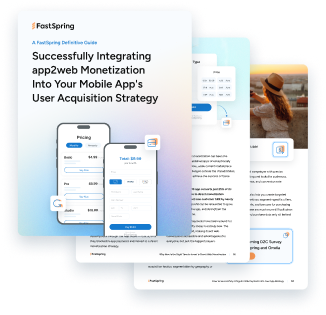
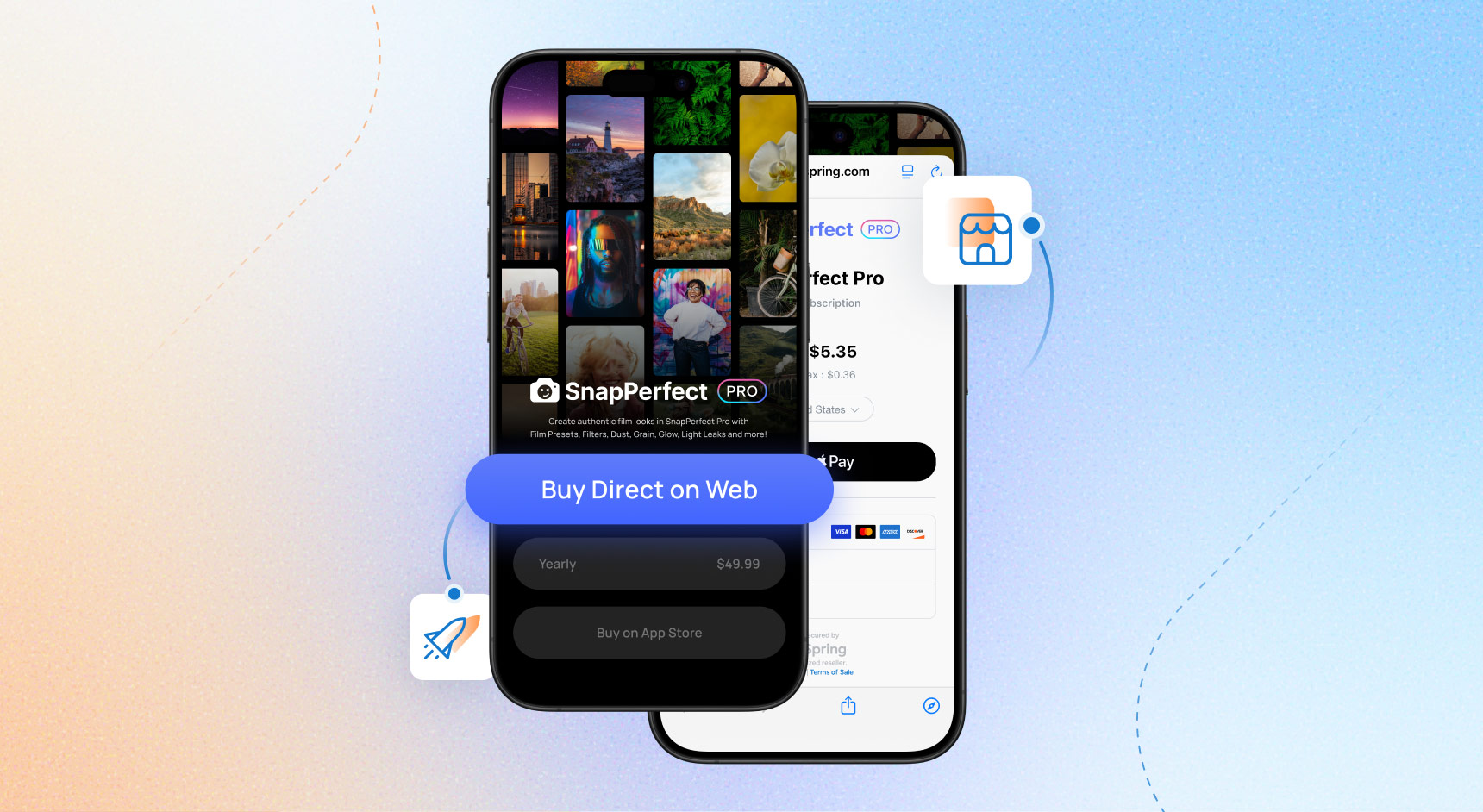
App2web means placing compliant links or buttons inside your app that sends users to your web checkout. With FastSpring’s Steer Safe™ approach, a user taps the link and lands on a localized checkout. Apple Pay and Google Pay are offered by default, or other local payment methods for wherever your buyer is located. After purchase, a deep link returns the user to the app, and your backend grants entitlement.
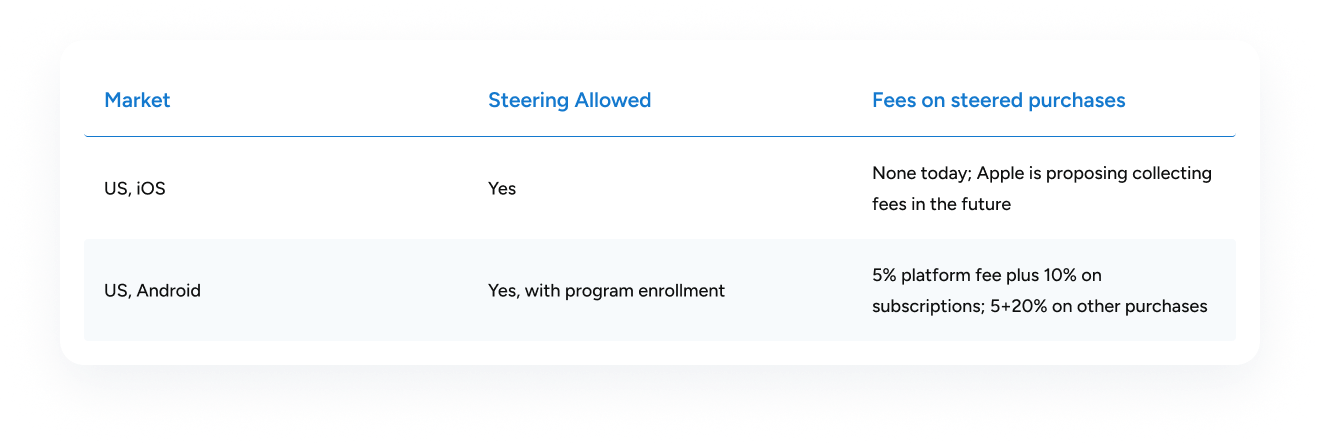
Where the rules stand
Steering is here to stay. What’s still being decided is if fees will be collected everywhere. Both Apple and Google now permit external purchase links in the US, and their proposed and active fee structures charge for steering rather than ban it outright as they’ve done in the past.
The Rules Have Changed, and They’re Still Moving
In the US, neither Apple nor Google can no longer block apps from pointing users to the web. Today, an app with users in the US can offer a web-checkout button (an app2web link or app2web messaging) alongside its in-app purchase options.
The terms are still in discussions and may change. Today, Google proposes a 20% fee (10% for subscriptions) on transactions through external billing plus the processing fee for the external payment provider, and Apple has proposed that it charge up to 20% on link-out purchases in the US. Outside the US, Apple already charges fees on linked-out purchases in the EU, Japan, and Brazil, with rules that vary by region.
None of these rules have slowed adoption, and there’s no evidence that apps are being punished when in compliance with app marketplace rules. 82% of top-grossing mobile apps now route payments outside the app store, and nearly 60% of mobile game studios already run a D2C web store, with 91% planning to launch one soon. With external links now part of the marketplace’s own rules, compliant steering is a fully sanctioned channel, not a trend or workaround.
And even as fees shift, the benefits of going direct still remain: owning the player relationship and first-party data, more control over pricing and promotions, and strategies you can deploy to grow revenue and reduce churn.
How to Choose Your Mix of Direct Monetization
Because these channels support each other and target different groups, it’s in your best interest to use all three in tandem:
What Mobile Game Publishers See With Direct Monetization Today
The companies going direct say the user relationship matters more than the margin. In our 2026 State of D2C Monetization survey of 110 senior leaders at game studios and publishers, margin ranked fourth among reasons for going direct.
Mobile games have moved faster on direct monetization than most app categories, so the results are a useful preview for subscription apps. A few insights that might be helpful:
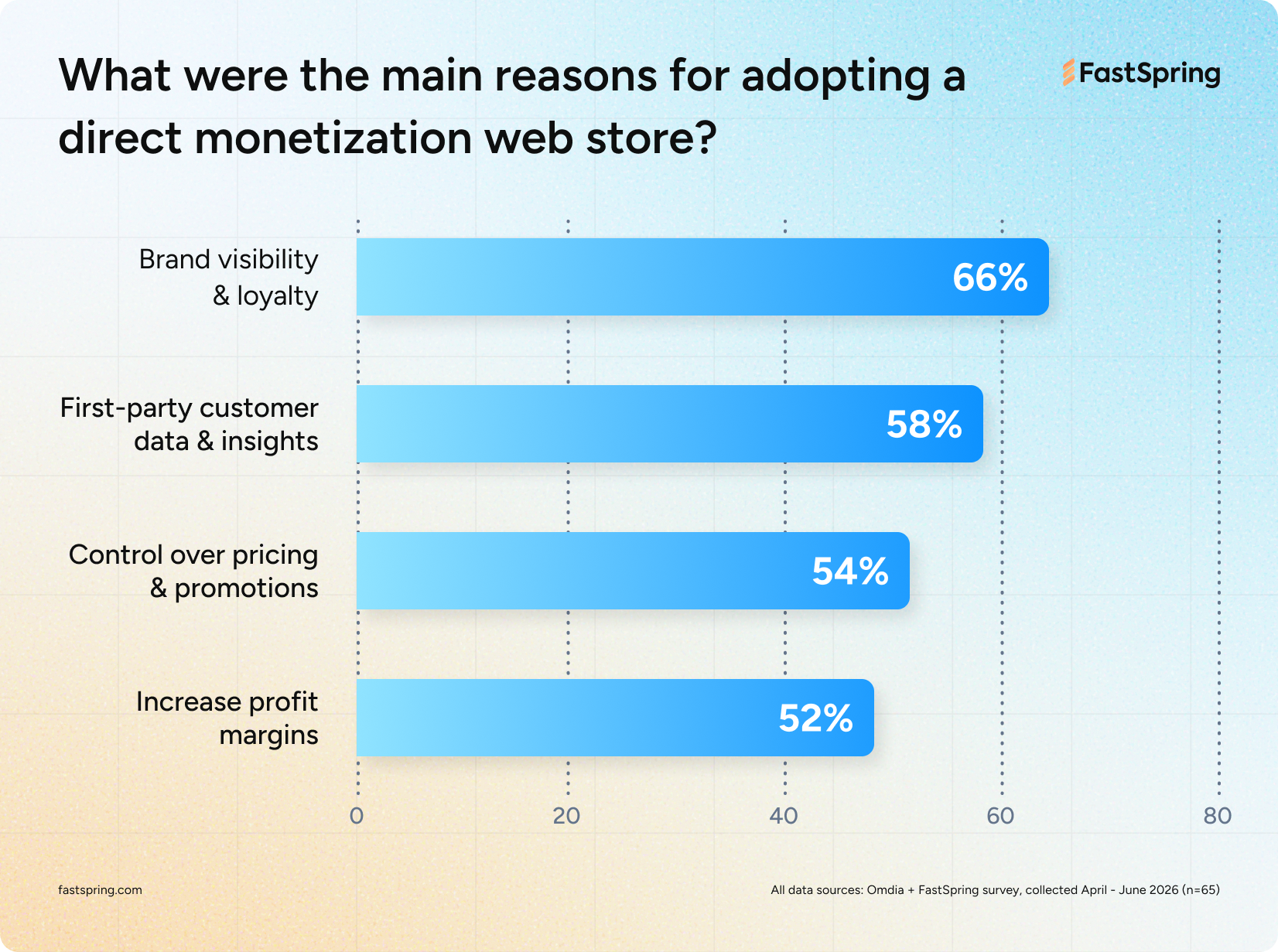
For subscription apps, this matters even more. The ongoing relationship with the subscriber is the product you’re selling, so being able to deliver an experience that improves brand visibility and user loyalty is a boon that is difficult to get from app marketplaces alone.
Investment is also growing from mobile game publishers. 88% of respondents plan to increase direct-channel investment in 2026, and 42% plan to increase it significantly, up from 33% in our 2025 survey.
And, among respondents already operating direct channels, three-quarters saw their share of revenue from direct sales rise over the past year. 84% say they met or beat their 2025 targets, and 66% beat them outright.
As an app publisher, what does this mean for you? The biggest names in mobile gaming are sending a clear signal; direct monetization is a meaningful growth vector and ignoring it is a mistake. For your app, taking a page from the mobile game playbook can help you grow in ways that aren’t possible from app marketplaces alone.
Key Takeaways
- Direct channels add to in-app purchases; they don’t replace them. Run web2app, app2web, and IAP together, each aimed at the users it reaches best.
- Web2App is a quick win. It acquires subscribers outside store commission, with attribution you can act on and conversion that often beats the store funnel.
- App2web reaches users no funnel can. On iOS in the US there’s no steering fee today. Take advantage and educate users on the value of going to your website for a subscription purchase.
- Fee savings compound with every renewal. Owning billing also gives you retention, pricing, and cross-sell levers that app marketplaces don’t.
- Steering is here to stay, act now. Steering regulations are changing, but it’s not going away. Take advantage of it while you can.
Ready to launch web2app or app2web steering? Learn more at fastspring.com/apps , or reach out to our team to schedule a demo today.