Buyer Support
 Seller Support


Can a mobile game really earn more than half its revenue from its web store? Yes. And more publishers and studios are getting there every quarter.
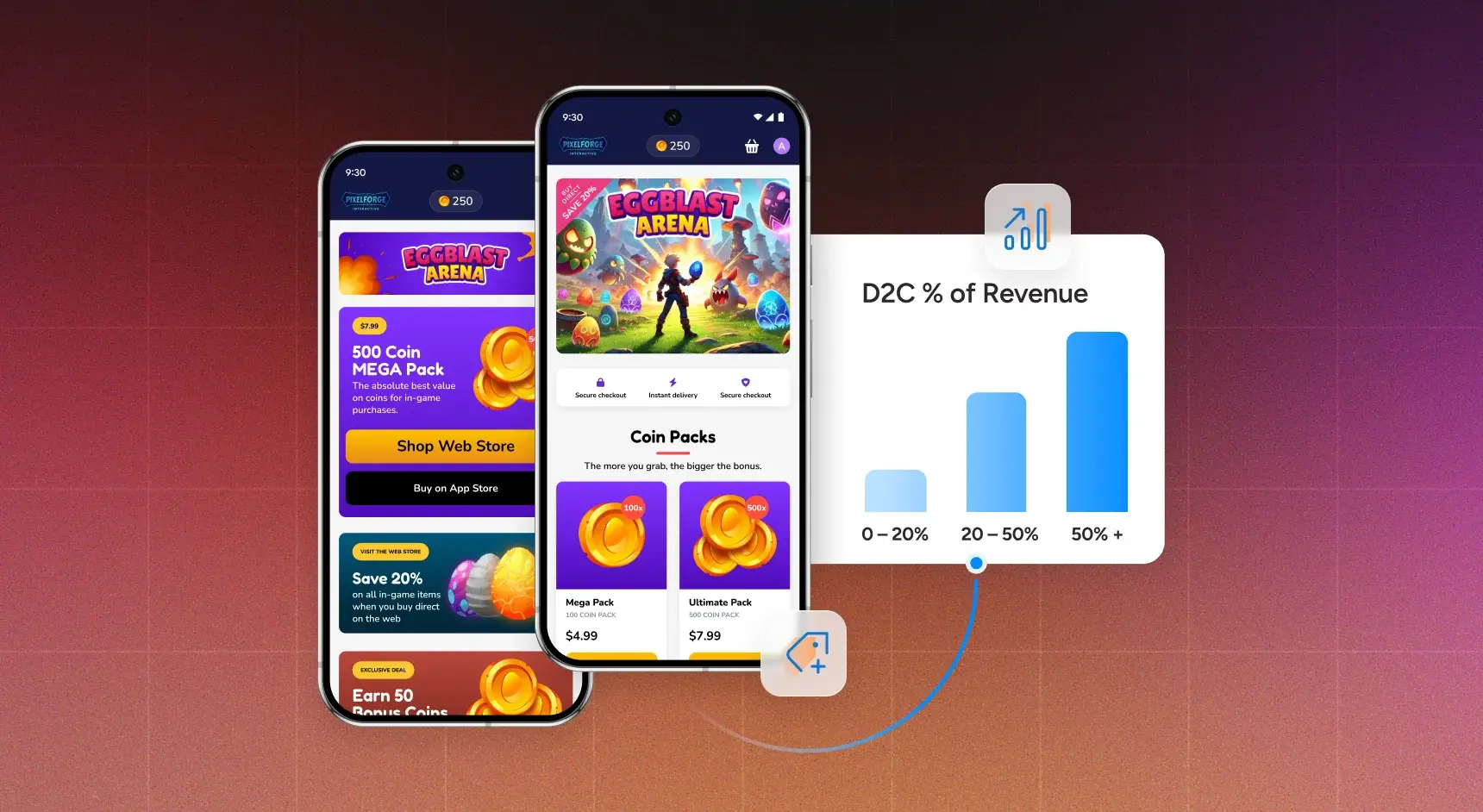
But launching a web store won’t get you there on its own. Across FastSpring’s internal data and external industry benchmarks, we see a clear pattern: Direct-to-consumer (D2C) revenue as a percentage of total revenue climbs in tiers, and each tier tracks the sophistication of a game developers’ go-to-market (GTM) strategy.
In other words, your web shop is only as strong as the engine driving players to it. Here’s how the benchmark tiers break down, and where your games likely sit today.
First Things First: Is Your Game Built for a Web Store?
Before we get to the tiers, let’s talk fit. Not every game monetizes the same way, and the games that win big with D2C tend to share a few traits.
They sell virtual items, currency, or passes. In FastSpring’s inaugural D2C survey with Omdia, the three most common monetization methods were paid in-game items, in-game currency, and battle passes or subscriptions. All three work very well on the web. Players buy in your store, and the goods show up back in the game through a linked account. If you’re monetizing a premium mobile game without in-app purchases, D2C may not always be a great fit for you. (Get access to FastSpring and Omdia’s 2026 State of D2C report here.)
A small group of players drives most of the revenue. If your VIPs (i.e. whales) account for a big share of spend, you only need to move a fraction of your audience to the web to see a major lift. High-value players also respond well to the kind of white-glove offers and exclusive bundles that are easy to build in your own store. You get the most leverage with your D2C campaigns if you can focus on VIPs.
They run live ops. Games with frequent events, seasons, and limited-time offers give players a steady stream of reasons to visit the store. Every new event is a new promotion.
They have an engaged community. Active Discord servers, creator followings, and social channels are where steering happens — outside the game, where there are much fewer rules and no fees at all from app stores. The stronger your community, the easier it is to drive traffic to your web shop.
That’s why midcore genres like RPGs, strategy, collectible card games, and many shooters are natural fits. Hybridcasual games with meaningful in-app purchase (IAP) revenue can benefit too. Games that earn mostly from ads, or premium titles with no in-game economy, have less to gain.
If your game checks these boxes, the question isn’t whether D2C will work — it’s how far up the tiers you can climb.
0%-20% D2C: The Store Is Live (But ~Nobody Knows It)
This is where most studios and publishers land right after launch. The tech is in place, payments are flowing, and the web shop works.
The problem? Your players barely know it exists. It’s also where many publishers sit today: Most respondents in our 2025 Omdia survey reported D2C at 10-29% of total revenue.
Studios in this tier typically have:
- Store links buried in settings menus or hard-to-find corners of the game.
- Little to no promotion on social media or Discord.
- Limited or no targeted offers for VIPs.
- No creator programs offering rewards for promoting the web store.
- No retargeting ads.
- No email marketing.
- No activation at esports events or other player communities.
The result: Your web shop captures your most dedicated players, the ones who go looking for a better deal. Everyone else keeps paying through the app store.
20%-50% D2C: Graduating From ‘In a Box’
Publishers and studios here have outgrown the out-of-the-box marketing and web shop-builder solutions that smaller developers and publishers often use for proofs of concept. D2C isn’t an experiment anymore; it’s a real revenue channel.
What this tier usually looks like:
- More prominent steering links in game.
- Active web shop promotion on social media and Discord.
- Targeted offers and campaigns for VIPs.
- Some creator rewards for promoting the web store.
- Minimal retargeting ads.
- Minimal email marketing for the web shop.
These publishers and studios have cracked awareness and have started to build a behavior with players who are coming back to the store again and again.
50%+ D2C: The Fully Integrated Playbook
Not long ago, this tier felt out of reach. Now, more and more game developers are hitting it. For these developers, D2C is a core part of the business, and every channel works together to drive players to the web shop and keep them coming back.
The playbook includes:
- A strong steering strategy.
- Sophisticated social media and Discord promotions.
- Extensive creator programs, complete with creator incentives.
- Targeted offers for VIPs, but also for all players based on player journey.
- Deep retargeting to drive repeat purchases.
- Comprehensive email marketing.
- A fully integrated strategy in which each channel amplifies the others.
- Exclusive offers with unique value propositions.
- Live operated features such as daily gifts to drive habituation.
At this level, the web shop isn’t an alternative checkout. It’s a destination for your players to engage with your game outside of the game itself. It’s where your relationship with your players lives, along with your data, your margins, and your best offers.
How to Level Up Your D2C Revenue
The benchmarks make one thing clear: D2C success isn’t about the store alone — it’s about GTM maturity.
Stuck in the 5%-25% range? Start with visibility. Make your steering links impossible to miss, and promote your web shop wherever your players already hang out. Sitting at 25%-50%? Shift your focus to retention. Use creator programs, retargeting, and email to turn one-time buyers into loyal, repeat customers.
Wherever you are today, the path to 50%+ is well marked. FastSpring helps mobile game studios at every stage, from launching a web shop to scaling a fully integrated D2C program, so you can spend less time on payments and compliance and more time making great games.
Ready to level up? Schedule a demo with our team, or visit fastspring.gg to learn more about how FastSpring supports game developers.