













Key Takeaways About a Merchant of Record:
- Unlike payment service providers (PSP), which handle only the processing of payments, a merchant of record (MoR) handles the end-to-end payment flow and takes on full liability for the transaction.
- Partnering with an MoR simplifies the financial and legal operation — and the timeline — required for digital-first businesses to sell globally, by handling tax collection and remittance, regulatory compliance, checkout localization, and more.
- The MoR model is often more cost-effective than ad hoc payments solutions.
Digital-first companies can easily sell to customers around the world, right? So why not market your product globally?
Anyone who does business across borders can tell you: It’s not that simple.
- Do you need to translate your website?
- Do you accept their country’s form of currency?
- Do you know local privacy and tax regulations?
We spoke to a software entrepreneur based in the Caribbean who was facing this issue.
Customers liked his products, and his company was growing rapidly. “But my country has less than a million people,” he told us. “If I really want to grow my business, I need to expand to other markets.”
He knew that selling his software in other countries would create a variety of tax, transaction processing, and compliance problems.
“That’s why I need a merchant of record,” he explained.
In this piece, we’ll explain what a merchant of record is — and why using one can make it much easier for digital-first companies to go global.
If you’re looking for a merchant of record to help you grow your business internationally, we can help. FastSpring provides an all-in-one payment and subscription platform for thousands of SaaS, software, video games, and digital products businesses, including VAT, GST, and sales tax management, payment localization, and consumer support. Interested? Set up a demo or try it out for yourself.
What Is a Merchant of Record?
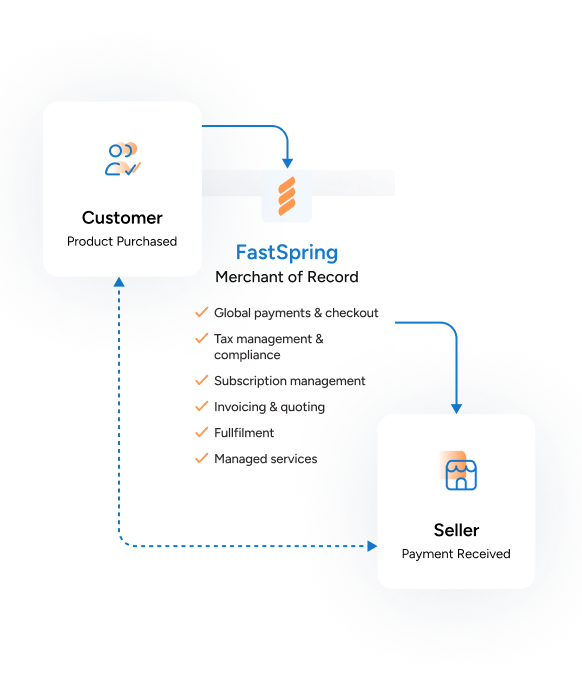
A merchant of record (MoR) is the legal entity that sells goods or services to a customer. Companies can be their own MoR, but you can also outsource this work to entities that sell goods or services on behalf of a business and, by doing so, take on the legal liabilities related to the transaction for you.
The merchant of record model helps you stop worrying about the regulatory and tax compliance issues involved with accepting payments from around the globe — so you can skip the hassle and focus on what you do best: building great products.
How Is a Merchant of Record Different From a Payment Service Provider?
A payment service provider (PSP) such as PayPal or iDeal is a platform that acts as a bridge, connecting sellers with back-end networks required for processing payments, such as payment gateways, payment processors, and merchant accounts.
You’re probably already working with one or two PSPs — whichever are most popular in your country or the country of your customers.
A PSP only handles the processing of payments, not anything else that goes into an order process, such as VAT (value-added tax), GST (goods and services tax), and sales taxes or payment disputes.
Some PSPs like Stripe accept multiple currencies — which is a big step towards being able to support customers from multiple countries, regions, or jurisdictions.
But various PSPs are popular in different places. And while PSPs are equipped to accept payments in different countries, they’re not responsible for helping you comply with tax requirements for each jurisdiction.
In comparison, a merchant of record handles all of that. The MoR becomes the seller of record (SoR) and, as such, the one to worry about differing rules across credit and debit card brands, regulations in each jurisdiction, consumption taxes, and general risk and liability.
Unlike with a PSP, when you partner with a merchant of record, it takes the lead on risk management, chargebacks, and global VAT, GST, and sales taxes for every transaction.
8 Reasons to Use a Merchant of Record
For many digital-first companies, taking the business global is a no-brainer. But doing so isn’t as simple as just deciding to. You need to think about:
- Navigating sales tax, VAT, and GST regulations.
- Figuring out how to accept multiple currencies.
- Understanding the nuances of regulatory compliance in various countries.
- Staying up to date on all of the above as regulations flux and evolve.
Solving for the above — and more — can add unnecessary complexity to your operations and slow down expansion plans.
That’s where a merchant of record can help your business grow more quickly, and with less liability, too.
1. A Merchant of Record Handles Sales Tax, VAT, and GST for Digital Goods
It’s one thing to ignore transaction-related taxes or kick the can down the road on figuring them out. But it’s a common mistake for companies to assume that sellers of digital goods aren’t required to collect or remit sales taxes, VAT, GST, and other consumption taxes for digital goods sold via online payments.
That just isn’t true. Sales of digital goods — including software, video games, mobile apps, etc. — often require the same consumption taxes as sales of physical products.
Ignoring that fact or putting off figuring it out could have disastrous consequences that reach well beyond just back taxes, ranging from exorbitant interest fees and penalties to multi-million dollar valuation adjustments.
A merchant of record is the ideal solution, allowing you to offload the complexity of sales, VAT, and GST tax collection and remittance. You can expand into new markets and regions quickly, all while avoiding the consequences of ignoring global tax laws altogether.
2. An MoR Covers Your Foundational Billing Tasks
Even before you add global selling into the mix, many software and SaaS companies struggle with foundational billing tasks, such as:
- Ensuring compliance with PCI-DSS standards for cardholder information, along with the EU General Data Protection Regulation (GDPR), California Consumer Privacy Act (CCPA), and Data Privacy Framework (DPF) requirements. (Visit our Trust Center here.)
- Decreasing payment failure rates.
- Managing and maintaining relationships with merchant banks, financial institutions, and payment processors.
- Negotiating payment processing fees.
- Handling payment disputes, refunds, and chargebacks.
- Calculating, filing, and remitting software sales tax, VAT, GST, and other consumption taxes.
- Risk analysis and fraud prevention.
- Reconciling transactions, payments, refunds, cash flow, and more.
Some of this work may be done for you by your accountant, subscription management platform, or payment processor, but they’re probably not doing everything — such as helping you decrease customer churn or issuing refunds.
Most likely (unless you’re already working with an MoR), you’re doing some of this work internally — or not at all.
All of the above is just one step. When you sell products to buyers in another country, things get even more complicated.
This kind of patchwork approach to billing tasks makes it easy for things to fall through the cracks — and it’s likely costlier than an all-in-one payments solution.
3. A Merchant of Record Calculates and Remits VAT, GST, and Sales Taxes for Digital Goods Based on the Buyer’s Location
When selling software or digital goods, VAT, GST, and sales tax are almost always calculated based on the location of your customer, not the location where you do business.
(This is different from professional services, which are often taxed based on where the service is performed, rather than the location of the buyer.)
For example, let’s say you sell software (or a digital product) and you choose a simple payment processor (such as Stripe or PayPal).
In that situation, if you have enough customers in Canada to meet the Canadian threshold for tax filing, then you must track, file, and remit taxes in Canada — regardless of your location or where your company is headquartered.
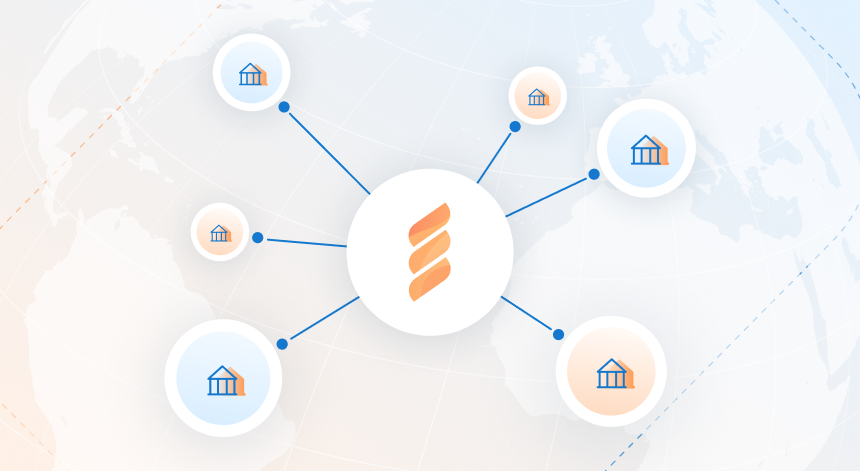
With a merchant of record, you’ll outsource the sales tax, GST/HST/QST, and many of the compliance responsibilities to your MoR — who will track, file, and remit taxes on your behalf, in Canada and in all the various countries where your customers live — instead of you doing that on your own.
(Did you know that, unlike the simpler VAT system that many countries and regions utilize, Canada actually has GST, HST, PST, QST, and even RST depending on the province? Canada applies several different tax types depending on the province or territory, so navigating compliance can get tricky quickly. If you didn’t already know that — and you don’t want to have to learn — a merchant of record might be what you need for your digital products business.)
If you multiply the above example by the number of countries where you have customers, you can see why so many digital-first companies choose the MoR model over simple payment processing when they expand globally.
With a merchant of record, you can grow your business much faster, with much less stress and hassle and much less cost from accountants and tax professionals.
4. A Merchant of Record Keeps Up With Ever-Changing Global Payment Rules for You
The specific requirements for doing business across borders vary from country to country, and they can vary further based on how much business you’re doing there, the structure of your business, and a variety of other factors.
Common steps for setting up successful cross-border business include, at a minimum:
- Learning the preferred local payment methods of a given region.
- Handling currency conversions when taking global payments.
- Understanding foreign tax requirements, including whether your offerings are subject to a value-added tax (VAT) or goods and services tax (GST).
- Detecting and handling fraud, which can be more prevalent on international payments.
That’s work you do per country, which means if you have a lot of customers in ten different countries, that’s ten sets of the above steps to figure out — a timely and costly process.
And this is the most important reason why it’s so helpful to use a merchant of record service when you’re ready to go global.
At FastSpring, we build and maintain relationships with tax law specialists around the globe, so we’re always up to date on laws and regulations if and when they evolve.
5. An MoR Simplifies Your Financial Operations
You didn’t start a software company to spend your days figuring out complex tax rules in countries all over the world. You started it because you had a great idea for a product, and you knew how to build it.
A merchant of record focuses on the selling, so you can get back to what you do best: making a great product.
The MoR acts as a reseller, buying the software from you, then reselling it to your customer. Instead of working directly with customers and myriad financial service providers, you communicate with just one entity — your MoR.
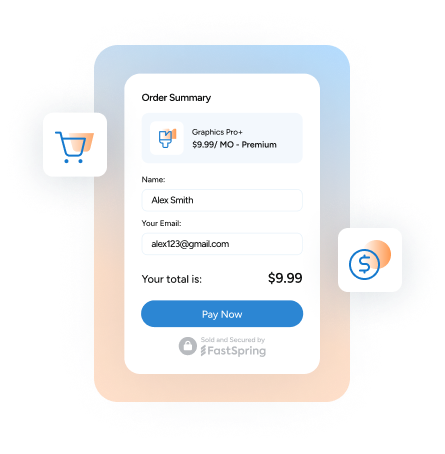
Your customers will still visit your website to buy software, games, in-game items, mobile app subscriptions, or other digital products — or to update their subscriptions — but when they’re ready to check out, they buy the products from the MoR.
They’ll receive a receipt from the MoR, and the MoR will be the company name listed on their bank account/bank statement or credit card statement. This is how the MoR becomes the liable party for the sale.
MoRs maintain robust ecommerce platforms to manage payment and tax processes — in addition to checkout localization and optimization.
At FastSpring, we also provide other services such as digital invoices and interactive quotes that are a part of our customer’s financial system.
6. A Merchant of Record Is Cost-Effective
If you’re paying a lawyer or accountant to figure out the tax obligations and business regulations of each country where your customers live, those costs add up fast. That’s before you even start localizing your payment platform, such as making sure your site accepts the preferred payment method of each country.
As an MoR, FastSpring already has an understanding of local taxes, payment gateways, and more. This makes it the most cost-efficient way to collect customer payments and remit taxes from a global customer base.
In summary, cobbling together a payment infrastructure that encompasses all the functions an MoR handles is a lot more costly and complex than dealing with one MoR partner.
7. A Merchant of Record Enables You to Go Global Immediately
Localizing pricing, currency, and your checkout flow for an optimal customer experience is a project that often takes years for companies that build those features on their own.
Since an MoR already has everything set up and ready to go, as soon as you become a customer of a global MoR, the currency, preferred payment options (from credit cards to digital wallets to global PSPs), and checkout experience can be customized for your customers right from the start.
8. A Merchant of Record Helps You Stay Compliant
Each country has its own sales and privacy regulations, and they’re always changing. This means you’ll need to keep a lawyer on retainer who’s familiar with the ever-changing global tax regulations if you’re handling compliance internally.
Once again, an MoR will do this work for you, avoiding costly fines and lawyer fees.
Frequently Asked Questions
What Does It Mean to Be a Merchant of Record?
A merchant of record (MoR) is the legal entity that sells goods or services to a customer. Companies can be their own MoR, but you can also outsource this work to entities that sell goods or services on behalf of a business and, by doing so, take on the legal liabilities related to the transaction for you.
What Is the Difference Between a Merchant of Record and a Payment Service Provider?
A payment service provider (PSP) is a platform that acts as a bridge, connecting sellers with back-end networks required for processing payments, such as payment gateways, payment processors, and merchant accounts.
A PSP only handles the processing of payments, not anything else that goes into an order process, such as tax calculations and remittance, payment disputes, or regulatory compliance.
To compare, a merchant of record handles all of that. The MoR becomes the seller of record (SoR) and, as such, the one to worry about differing rules across credit and debit card brands, regulations in each jurisdiction, consumption taxes, and general risk and liability.
Your MoR, then, takes the lead on risk management, chargebacks, and global VAT, GST, and sales taxes for every transaction.
What Are the Benefits of Partnering With an MoR?
The most important benefits of partnering with an MoR include:
- Reducing the financial and legal burden on your company.
- Allowing you to expand globally immediately.
- Freeing you from having to calculate and remit taxes in every jurisdiction you sell to, and from having to stay up to date on ever-shifting regulations.
- Saving you money with a more cost-effective, all-in-one platform versus patchwork payment processing, subscription management, and accounting solutions.
- Improving your customer experience and boosting conversions thanks to features like advanced payment routing to mitigate payment failures, localized checkout, acceptance of preferred payment methods around the globe, consumer support, and more.
What Are the Key Responsibilities of an MoR?
Key responsibilities of an MoR include:
- Global online payment processing.
- Tax and regulatory compliance.
- Fraud prevention and risk management.
- Handling payment disputes, refunds, and chargebacks.
- Subscription management.
In summary, an MoR handles the end-to-end payment infrastructure, from localizing your checkout flow and processing payments to calculating and remitting consumption taxes like sales tax, VAT, GST, and more.
How FastSpring Can Help
FastSpring is the leading full-stack merchant of record service for growth-stage SaaS, software, video game, mobile app, and other digital products businesses. If you’re looking for a merchant of record to help your business expand globally, we’re here to help.
Our platform serves as an all-in-one payment and subscription platform that handles everything from payment and checkout localization; to sales, VAT, and GST tax management; to customer support for end consumers, and so much more.
Learn more about how FastSpring can help you grow your business globally: Set up a demo or try it out for yourself.
This post was originally published in 2021 and has been updated.