









 Buyer Support
 Seller Support



The AI field is moving at breakneck speed, but many companies still struggle with a fundamental challenge: turning their app into a sustainable, profitable business.
Your payments infrastructure is the foundation that determines whether you can scale globally, retain customers, and actually make money on each transaction. AI app builders face unique monetization challenges — from evolving regulations and taxes to the potential for more frequent chargebacks — that require more than a basic payment processor can solve for.
Below, we walk through:
- The SaaS fundamentals every AI app business needs to master.
- Monetization challenges unique to AI businesses.
- How to monetize a web app versus a mobile app.
- How FastSpring can help.
FastSpring allows you to offload the complexity of global payments, VAT/GST and sales tax compliance, consumer payments support, and many other aspects of payments management. Spend less time managing your payments and compliance and more time building groundbreaking AI products! Set up a demo or try it out for yourself.
Start With SaaS Fundamentals
At their most basic, the majority of AI apps are still fundamentally SaaS businesses. Whether it’s a monthly subscription to your writing assistant or an annual plan for your analytics platform, the majority of AI tools run on recurring revenue.
So while you may be selling AI services instead of project management software, the core monetization principles are similar to those of subscription businesses.
Before diving into AI-specific challenges, you should nail the basics — things such as:
- Communicating well with customers around subscription terms, payments, and any changes to your business or delivery model.
- Managing and mitigating churn.
- Choosing a payment provider.
But subscriptions come with complexity. You also need to handle free trial conversions, manage failed payments through dunning processes, and deal with upgrades, downgrades, and cancellations.
Companies that have navigated this model (such as FastSpring customer Stardock) know you need a payment partner built specifically for subscription management — not just one that can process one-time charges.
Things to Consider When Selling Software or Apps Globally
When you’re selling AI apps worldwide, you need to solve several problems simultaneously:
Preferred payments and checkout that vary by region. Localized payment methods are critical for conversion. Customers expect to see prices in their currency and be able to pay using familiar methods. Customers in the U.S., for example, expect to see Apple Pay and Google Pay, while customers in Brazil prefer to pay with Pix, and customers in India want to use UPI.
Global tax calculation and remittance. If you’re selling digital services to customers based in the EU, you need to collect VAT at each buyer’s local rate and file those taxes accordingly. In the U.S., sales tax requirements vary state by state, and some states even let individual counties or cities set their own rates and rules. Each requires separate filing. Handling this yourself means registering with tax authorities in, potentially, hundreds of jurisdictions. Plus, you’re liable for any fines or penalties resulting from doing so incorrectly.
Data and platform governance. You need to process payment data securely according to regional requirements, meet data residency rules in certain jurisdictions, and maintain PCI compliance. These aren’t optional — they’re legal requirements that can shut you down or cost you hefty penalties if not followed.
Why You Want a Merchant of Record (Not Just a Payment Processor)
When choosing how to handle payments, your first and crucial choice is whether to use a basic payment service provider (PSP) or partner with a merchant of record (MoR).
A payment service provider (such as Stripe) gives you the tools to process transactions, but you remain legally responsible for every transaction. You’re in charge of calculating, collecting, and remitting taxes — in every jurisdiction where your customers live — and you carry the liability for any fraud. (Stripe is launching an MoR service, but how it will perform is still unknown.)
A merchant of record, on the other hand, becomes the legal seller of your product. FastSpring is an MoR, so we assume liability for transactions — meaning you can spend less time worrying about managing taxes and chargebacks and more time building a great product.
As the liable party for the sale, an MoR such as FastSpring handles:
- Global tax compliance. You don’t need to figure out VAT rates across EU countries, navigate state-by-state sales tax rules in the U.S. (and in some cases even city-by-city variations), or file returns in those jurisdictions. An MoR automatically calculates, collects, and remits those taxes for you.
- Consumer support for payment issues. When someone’s card declines or they have a billing question, your MoR’s support team handles it.
- Fraud prevention and risk management. Using a simple payment service provider and acting as your own merchant of record could lead to less financial industry credibility, as AI services are often perceived as riskier than other tech verticals — and in turn, that could lead to lower approval rates. Conversely, the established credibility of an experienced merchant of record such as FastSpring (with over two decades of experience!) helps improve transaction approval rates, which means higher revenue and less headaches.
- Checkout and payment localization. Instantly offer global payment localization including currency conversion, checkout translation, global tax management, and localized payment processing.
- Global compliance. Your MoR maintains PCI-DSS certification, data protection regulations, and customer authentication requirements so you don’t have to. Learn more in FastSpring’s Trust Center.
FastSpring allows you to offload the complexity of global payments, VAT/GST and sales tax compliance, consumer payments support, and many other aspects of payments management. Spend less time managing your payments and compliance and more time building groundbreaking AI products! Set up a demo or try it out for yourself.
Questions to Ask When Evaluating Payment Solutions
Before committing to a payment solution — be it a payment processor or merchant of record — ask these questions to help you evaluate:
- Does it handle global tax collection and remittance automatically, or do you need to register, collect, and file in every jurisdiction where your customers live?
- Which payment methods are supported? Can customers in your target market(s) use their preferred options?
- How does it handle subscription management? What about usage-based or metered billing? Does it offer a portal for customers to self-manage subscriptions, billing, and payment methods on file?
- Does providing consumer payment support fall to you or to your payment provider?
- Does it integrate with your existing tech stack?
- What are your actual, all-in costs — including processing fees, tax filing, compliance management, and operational overhead?
What Makes AI Different: Unique Monetization Challenges
Once you’ve nailed the fundamentals for subscription-based businesses, you can begin to grapple with the unique challenges of monetizing an AI app.
Operating in a Young, High-Growth Market = Constant Change
AI companies are scaling globally faster than almost any previous software category. You’re not gradually expanding into new markets over several years — you’re able to serve customers worldwide pretty much from day one.
This creates challenges that more mature software categories simply didn’t face when they were at the same stage. Burgeoning AI companies are now faced with:
- Regulatory landscapes that vary dramatically by region, especially as they apply to digital services businesses. Evolving tax regulations (especially on digital goods or services) create compliance requirements that change based on where your customers are located — and these regulations will continue to emerge, grow, and evolve across the globe. For example, in 2024, five U.S. states simplified their criteria for tax nexus, which meant more businesses might meet the criteria for nexus sooner than they expected to — including digital goods businesses. And in 2025, the Philippines extended its VAT legislation to cover digital services supplied by foreign companies to consumers in the Philippines. If you use an MoR such as FastSpring, the MoR will worry about staying up to date with those types of regulations so you don’t have to.
- Evolving customer expectations and pricing norms. Unlike established software categories where pricing patterns are well understood, AI pricing is more fluid. Customers aren’t yet sure what they should pay, and you may not be sure what you should charge. To quickly and easily pivot your pricing as needed, choose a payment partner with agile pricing tools. For instance, FastSpring’s flexible Store Builder Library makes it easy for software and app sellers to update their product pricing quickly.
- Overly cautious payment processors. As we mentioned above, because the category is new and patterns aren’t established, some payment processors may be more likely to treat AI as high-risk. But since FastSpring processes billions of dollars across numerous software categories and has been for 20+ years, partnering with us means that you’ll benefit from better approval rates. Banks see transactions coming from a known, trusted entity with a proven track record, not an unproven AI startup.
- Technical challenges with usage-based billing. Unlike SaaS products that have been more commonly monetized with traditional monthly or annual subscriptions, AI services are particularly well served by usage-based billing, so support for that feature is something you’ll likely want from a monetization partner. If you want to be able to charge users in combination with real-time metering and tracking of usage, your backend needs to integrate with your payment systems. FastSpring supports usage-based billing through API integration and webhooks.
Monetizing AI Web Apps vs. AI Mobile Apps
Your monetization strategy will differ depending on whether you’re building a web app, a mobile app, or both.
AI Web Apps: The Direct Approach
Web-based AI apps have built-in advantages for monetization:
- No mandatory iOS and Android platform fees.
- Full control over the customer relationship.
- Direct access to first-party customer data.
To make web monetization work, you need:
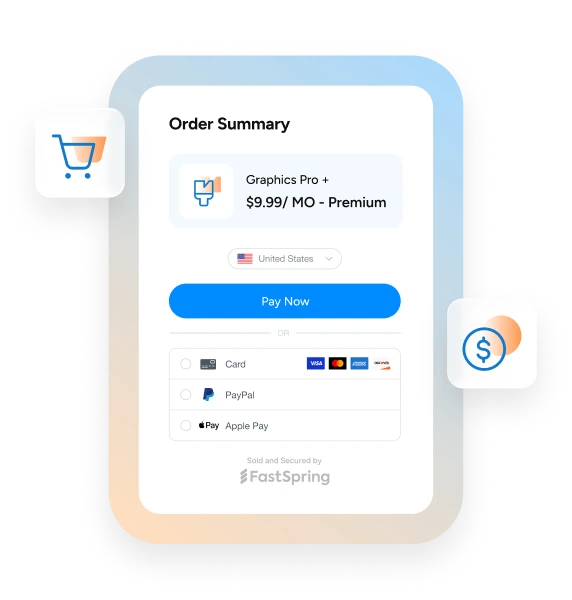
- An optimized checkout experience with multiple payment methods, localized currencies, and trust signals that convince customers you’re legitimate and secure.
- A subscription management portal where customers can self-serve to upgrade, downgrade, view usage, update payment methods, and access their billing history.
- Integration flexibility through APIs for usage-based billing, webhooks for entitlements, and backend system connections that tie everything together.
FastSpring’s JavaScript Store Builder Library lets you quickly create a branded, seamless checkout experience that feels native to your app environment, while handling all the back-end complexity for you.
AI Mobile Apps: The App2Web Opportunity
If you’re building a mobile AI app, you’re facing 15-30% platform fees that eat into your margins. For AI apps with high compute costs, losing nearly a third of revenue to platform fees can strain the calculus at best — or make the economics totally unworkable at worst.
But that’s the cost of doing business with iOS and Android, right?
Not necessarily.
With app2web and web2app monetization strategies, you can sell an AI app outside popular app stores. You can recover some of that lost revenue by building a web store to monetize via the web and offering customers some kind of incentive — discounts, upgrades, in-app usage bonuses, etc. — for buying directly from you.
By doing so, you:
- Minimize the transactions on which you incur those hefty commission fees.
- Gain access to valuable first-party customer data that enables smarter acquisition campaigns, personalized promotions, and better lifecycle marketing.
- Improve margins, which is crucial when you’re paying for compute on every transaction.
While regulations around in-app steering and promotion of outside payment options vary from region to region and are ever evolving, you can always:
- Distribute your product through a web store. Selling your app’s solution directly to your consumers through your own store is an increasingly common and effective monetization strategy.
- Market your web store outside the app through social media, Discord communities, Reddit threads, email campaigns, and other channels where you aren’t restricted by app store rules.
- Build a web presence for existing users, and incentivize web store visits through exclusive offers or better pricing.
Making User Acquisition Smarter With First-Party Data
When you monetize through the web, you unlock first-party data that holds the power to supercharge your user acquisition strategy.
You can track attribution accurately, understanding which campaigns drive conversions.
You gain access to email addresses, payment preferences, referral sources, and session behavior — data points that enable sophisticated segmentation.
Then you can turn that valuable data into:
- Localized user acquisition strategies with geographic and behavioral segmentation, region-specific pricing and promotions, and language/payment method optimization.
- Targeted social campaigns where you build custom audiences from web purchasers, create lookalike audiences based on high-intent users, and retarget with actual conversion data instead of guesswork.
- Email marketing automation that drives users to web purchases, re-engages lapsed customers, and converts free users to paid plans.
Monetize Your AI App With FastSpring
FastSpring is built specifically for digital-first businesses that need to monetize globally, without getting bogged down building their own global payments infrastructures — or cobbling them together via disparate payment tools.
Our platform offers:
- Complete merchant of record services covering global tax compliance across 200+ jurisdictions, local payment methods and currencies, fraud prevention and risk management, and PCI compliance and data security.
- AI-friendly billing capabilities including out-of-the-box subscription management, flexible product catalog management, multiple pricing models (flat, tiered, hybrid), and support for usage-based billing (with proper integration).
- Developer-first integration through RESTful APIs for backend connections, webhooks for real-time event notifications, our JavaScript Store Builder Library, integration with RevenueCat for mobile apps, and backend integration for usage-based billing.
- Customizable checkout experiences with branded checkout; your choice of embedded, pop-up, or web storefront experiences support for trials, coupons, and promotions; and management of multiple subscription tiers.
- Fast implementation with quick setup for standard configurations, flexibility for complex requirements, pre-existing compliance infrastructure, and the ability to focus your engineering resources on AI instead of payments.
FastSpring helps AI app developers navigate the complexity of global monetization and scale successfully. We’ve spent over 20 years helping digital-first companies grow, and we’ve built our platform specifically for businesses like yours.
FastSpring allows you to offload the complexity of global payments, VAT/GST and sales tax compliance, consumer payments support, and many other aspects of payments management. Spend less time managing your payments and compliance and more time building groundbreaking AI products! Set up a demo or try it out for yourself.